Created: 10 September 2026 · Last edited: 3 September 2026
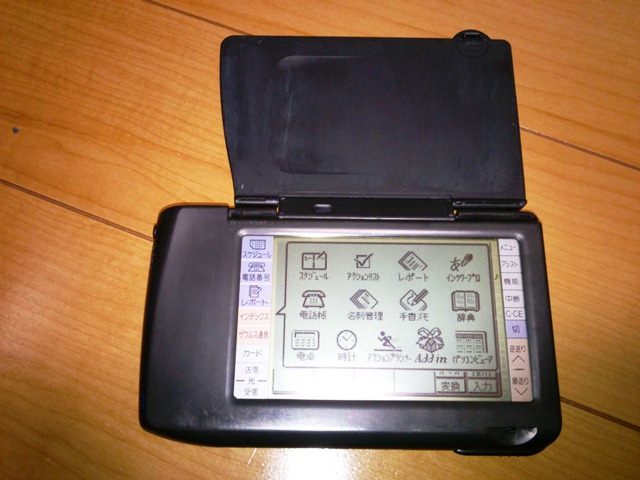
The Zaurus PI series was the original generation of Sharp's Zaurus personal information devices, establishing a product line that would become one of the most prominent PDA families in Japan during the 1990s. The first commercial model, the PI-3000, was released in October 1993, following a Zaurus proof-of-concept known as the Pi² T that Sharp had presented the previous year. Sharp described the PI-3000 as a new type of personal information tool that brought together the business functions users needed in a single compact device.
The PI series was built around a pen-based interface and a monochrome dot-matrix display, with handwriting recognition providing the principal means of entering information. Rather than being simply an electronic organiser, however, the Zaurus concept increasingly incorporated communications and connectivity features as the series developed. Fax transmission appeared early in the range, followed by PC connectivity, e-mail and eventually Internet-related capabilities. Sharp itself credits this continuing expansion of functionality with helping the Zaurus create a new market and become one of the company's flagship product lines.
During its four-year evolution, the PI series progressed from the relatively straightforward PI-3000 to increasingly capable AccessZaurus models. The PI-4000 introduced an electronic "ink" function and was followed by the fax-equipped PI-4000FX. The PI-5000 generation added PC synchronisation and add-in capabilities, while the PI-4500 combined the PI-4000 platform with the expansion capabilities of the PI-5000. Later models introduced improved handwriting recognition, cellular-phone connectivity and a built-in modem.
The later PI models also became smaller and lighter while increasing their available memory. The PI-6000, PI-7000, PI-6500 and PI-6600 used a compact 147 × 87 × 17 mm body, while the PI-8000 introduced a larger 319 × 168-dot display in a slightly larger enclosure. Memory had grown from 288 KB in the PI-3000 to 1 MB in the later AccessZaurus models.
The final PI model, the PI-6600, was released in September 1997, bringing the original Zaurus PI generation to an end. By this point Sharp had moved considerably beyond the concept embodied by the first PI-3000: the Zaurus had evolved from an electronic organiser into a sophisticated communications-oriented PDA, paving the way for Sharp's subsequent MI and, eventually, Linux-based SL generations.
Specifications
- CPU: Sharp ESR-L (SC62015) — 2.304 MHz
Advertisement
Zaurus PI PI-3000 — PI-6600
- Waterproofing: None
- Dustproofing: None
- Configuration 1: Operating memory (RAM) 288 KB, External storage IC card
- Configuration 2: Operating memory (RAM) 544 KB, External storage IC card
- Configuration 3: Operating memory (RAM) 1 MB, External storage IC card
PI-3000
The PI-3000, released in October 1993, was the first commercially available Zaurus. Sharp marketed it as a new kind of personal information tool, combining business-oriented functions in a compact pen-operated device. It had a 239 × 168-dot monochrome display, handwriting recognition and optical communication capabilities. Its 288 KB of memory was modest even by contemporary standards, but the combination of organiser functions and pen input established the basic Zaurus concept.
The PI-3000 was preceded by the Pi² T, a proof-of-concept Zaurus presented in April 1992. The Pi² T was never sold commercially and therefore represents the conceptual beginning of the Zaurus rather than a production device.
PI-4000 / PI-4000FX
The PI-4000, released in June 1994, was the second generation and expanded on the original concept with an electronic "ink" function. The PI-4000FX added fax functionality, illustrating the direction in which Sharp was developing the Zaurus: it was becoming a communications device as well as an electronic organiser. The PI-4000 had 544 KB of memory and retained the 239 × 168-dot display.
PI-5000 / PI-5000FX / PI-5000DA
Only a few months later, the PI-5000 generation appeared in November 1994. This was an important step because the Zaurus gained the ability to synchronise data with a personal computer, together with add-in capabilities. The range included the PI-5000, fax-equipped PI-5000FX and PI-5000DA variant. Memory increased to 1 MB, while the display remained a 239 × 168-dot monochrome matrix.
PI-4500
The PI-4500, released in January 1995, combined the basic PI-4000 platform with the add-in functionality introduced by the PI-5000. It therefore represented a transitional step between the earlier organiser-oriented machines and the increasingly expandable AccessZaurus products. It retained 544 KB of memory and the 239 × 168-dot display.
PI-6000 / PI-6000FX
The PI-6000, released in August 1995, introduced improved handwriting-recognition software and adopted a substantially smaller and lighter enclosure. Its 147 × 87 × 17 mm body weighed about 195 g including batteries, while memory had increased to 1 MB. The related PI-6000FX added fax functionality.
PI-6000DA
The PI-6000DA, released in December 1995, extended the PI-6000 platform with a digital adapter for cellular phones. This was another indication of Sharp's increasingly communication-oriented approach to the Zaurus. It retained the compact 147 × 87 × 17 mm body and 1 MB of memory.
PI-7000
The PI-7000, released in February 1996, was marketed as an AccessZaurus and incorporated a built-in modem. It retained the compact 147 × 87 × 17 mm form factor while weighing approximately 200 g. The built-in modem made the Zaurus substantially more self-contained as a communications device.
It is worth noting that the name PI-7000 ExpertPad also appeared in this period, but that was an unrelated Newton-based device and should not be confused with the Zaurus PI-7000.
PI-6500
The PI-6500, released on 22 November 1996, continued the compact AccessZaurus design. It had 1 MB of memory, a 239 × 168-dot display and weighed approximately 195 g. Its user-addressable memory was reported as 715 KB.
PI-8000
The PI-8000, released on 24 January 1997, was a more substantial departure from the compact PI-6000/6500/7000 body. Its display increased to 319 × 168 dots, while the enclosure grew to 157 × 90 × 17 mm and its weight increased to approximately 215 g. It retained 1 MB of memory, of which about 711 KB was user-addressable.
PI-6600
The PI-6600, released on 25 September 1997, was the final PI-series Zaurus. It returned to the compact 147 × 87 × 17 mm body used by several preceding AccessZaurus models and retained the 239 × 168-dot display and 1 MB of memory. Its release marked the end of the original PI generation.