Created: 11 October 2026 · Last edited: 12 October 2026
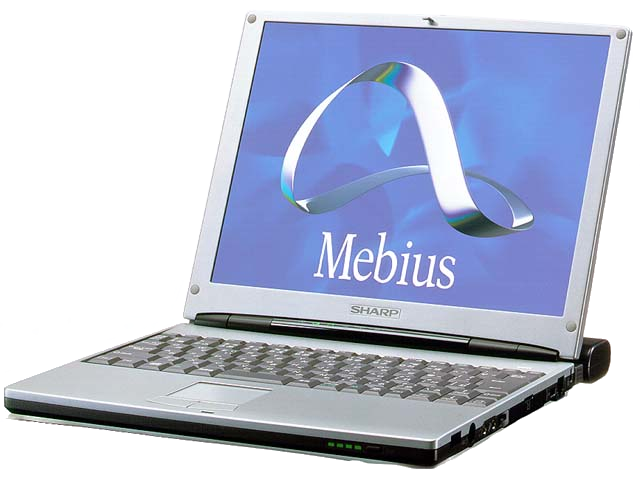
Presented at the Tokyo Business Show in May 1998, the Mebius Note PC-PJ1 was an exceptionally thin and lightweight B5-class notebook with a magnesium-alloy chassis. It weighed 1.37 kg and measured just 21.2 mm at its thinnest point (259 × 212 × 21.2 mm). Sharp says its 11.3-inch display was "the largest in its class", and the PJ1 certainly made an impressive use of its compact footprint, offering a larger screen than comparable notebooks such as the Sony VAIO PCG-505EX, Toshiba DynaBook Portégé 300, and Mitsubishi Pedion.
The Sony VAIO PCG-505EX weighed 1.35 kg and measured 259 × 208 × 23.9 mm, making it almost identical in size to the Sharp, but it had a smaller 10.4-inch display (800 × 600).
The Toshiba DynaBook Portégé 300 measured 263 × 192 × 35 mm. Its footprint was fairly close to the Sharp's, although it was considerably thicker. It also weighed 1.7 kg and had a 10.4-inch display (800 × 600).
The Mitsubishi Pedion had a 12.1-inch screen (800 × 600), but its dimensions of 297 × 218 × 18 mm gave it a footprint larger than an A4 sheet of paper.
Such a compact and lightweight design did not, however, come at the expense of performance. The PJ1 was powered by an Intel Pentium MMX processor clocked at 233 MHz, with 32 KB of L1 cache and 256 KB of secondary cache, just like the Sony and Mitsubishi models (the Toshiba's processor ran at 133 MHz, though). The PJ1 came with 64 MB of fixed, non-expandable RAM, matching the Sony and Mitsubishi models. It had 1.1 MB of video memory and a NeoMagic NM2097 graphics adapter, just like the Sony, while the Mitsubishi used an earlier NeoMagic MagicGraph 128 adapter. The Toshiba, meanwhile, had a Chips and Technologies CT65554 graphics adapter with 2 MB of video memory to drive its 1024 × 600 widescreen display. Onboard storage was also fairly similar: the Sharp had a 3.2 GB HDD, compared with 2.1 GB in the Sony, 1.6 GB in the Toshiba and 1 GB in the Mitsubishi.
The 800 × 600 display could reproduce the then-standard 65,536 colours. Switching to the lower resolution of 640 × 480 allowed it to display 16.77 million colours.
By 1998, the internet was becoming a global phenomenon, and the PJ1 came with a built-in 56 kbps modem. The Sony VAIO and Toshiba DynaBook also had built-in modems, but theirs topped out at 33.6 kbps. With the Mitsubishi Pedion, you needed a PC Card modem to connect to the internet.
All four notebooks had IrDA ports capable of transfer speeds of up to 4 Mbps.
Last but not least, let's look at the prices of these top-notch machines. Here's how they rank, from cheapest to most expensive:
- Sony VAIO PCG-505EX/64 – ¥300,000
- Sharp Mebius Note PJ PC-PJ1 – ¥385,000
- Toshiba DynaBook Portégé 300 – ¥458,000
- Mitsubishi Pedion – ¥578,000–¥728,000
I believe the Sharp wins in just about every respect – and clearly on balance. No wonder Sharp's 1998 history page states: "This new model established Sharp as a leading brand in notebook PCs."
Specifications
- Display: 11.3 inches, 800 × 600 px — TFT LCD
- CPU: Intel Pentium MMX (P55C) — 233 MHz
- Operating system: Windows
- OS version at launch: 95
Advertisement
SHARP Mebius Note PJ PC-PJ1
- Waterproofing: None
- Dustproofing: None
- Operating memory (RAM): 64 MB
- Built-in storage memory: 3.2 GB
- External storage: PC Card Type II