Created: 20 October 2026 · Last edited: 22 October 2026
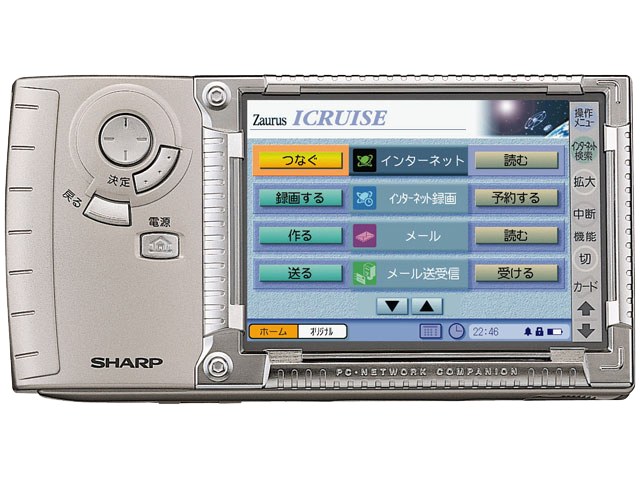
The Zaurus iCRUISE MI-EX1, released in April 1999, represents one of the most significant advances of the MI generation. It introduces a 4-inch, low-temperature polysilicon colour TFT display with a 640 × 480-pixel VGA resolution and support for 65,536 colours. This is the world's first PDA with a VGA display. This is a substantial improvement over the 320 × 240-pixel screens of earlier colour Zaurus models, providing much more room for viewing Web pages, photographs and other information.
Despite its larger, higher-resolution display, the MI-EX1 measures just 161 × 83 × 23 mm and weighs approximately 255 g with its battery.
The processor powering it is from the familiar Hitachi SH-3 family but now the SH7709A, clocked at 120 MHz (estimated).
The MI-EX1 is designed particularly around Internet access and, to facilitate navigation, it introduces iCRUISE, the Internet navigation feature that gives the model its name. A dedicated scroll control makes browsing Web pages easier with one hand, without having to take out the stylus. The built-in 33.6-kbit/s modem and support for connections through compatible mobile phones and PHS devices provide several ways to access the Internet. Its browser supports SSL and cookies, although it lacks support for CSS, XML, Java and JavaScript. Sharp also promote its Space Town online service, which offers free and paid content, and a function that automatically accesses specified websites at scheduled times.
Sharp also expands the ways users can collect and organise information. The new My Contents function offers 19 built-in templates for arranging information with photographs, making the Zaurus useful for more than conventional personal information management (PIM). The 24 MB of built-in memory include approximately 16 MB available for user data, while a CompactFlash Type II slot allows further expansion. An optical infrared port supports wireless data transfer.
PC integration has been improved through a cradle supplied as standard. Connecting the MI-EX1 to a Windows 95 or Windows 98 computer allows users to synchronise personal information, transfer photographs and exchange data with their PC. This makes the device more practical as part of a wider computing setup rather than an isolated electronic organiser.
Optional accessories extend its multimedia capabilities. The CE-AG05 digital camera unit, priced at 45,000 yen, features a 0.85-megapixel CCD sensor and can capture images at up to 1,024 × 768 pixels. Users can organise photographs into electronic albums, annotate them with stamps or handwritten notes, and send them by e-mail. The camera also offers close-up photography from as near as 10 cm, 1.6× digital zoom and a document mode for photographing items such as business cards. Other options include a video-output card for displaying the Zaurus screen on a television or projector, a portable keyboard, and cables for connecting to mobile phones and PHS devices.
Priced at 160,000 yen at launch, the MI-EX1 is positioned as a high-end Internet-oriented PDA. Its combination of a VGA colour display, compact design, online services, expandable storage and camera integration demonstrate how far the Zaurus platform has evolved from its origins as an electronic organiser.
Specifications
- Display: 4.0 inches, 640 × 480 px — LTPS TFT LCD
- CPU: Hitachi SH7709A — 60 MHz
- Operating system: Zaurus OS
Advertisement
Zaurus iCRUISE MI-EX1
- Waterproofing: None
- Dustproofing: None
- Operating memory (RAM): 8 MB
- Built-in storage memory: 16 MB flash
- External storage: PC Card Type II
https://pc.watch.impress.co.jp/docs/article/990412/sharp.htm
Zaurus iCRUISE MI-TR1
- Waterproofing: None
- Dustproofing: None
- Operating memory (RAM): 8 MB
- Built-in storage memory: 8 MB flash
- External storage: PC Card Type II
The MI-TR1 is a specialised business version of the MI-EX1 developed for financial and securities applications. It retains the high-resolution colour display and PC Card capability of the iCRUISE but uses a customised software configuration and reduced memory capacity. It is not a general consumer model, but it is notable as an example of Sharp adapting the MI platform for specialised professional applications.