Created: 9 August 2026
In early 2000, Sharp announced two new Telios mobile computers, the HC-7000 in Europe and the HC-VJ1C in Japan. The Telios HC-7000 was showcased at CeBIT2000, an IT and telecommunications trade fair starting 23 February 2000*, whereas the HC-VJ1C followed just two days later (announcement – sales began on 10 March).
In Japan, the Telios HC-VJ1C was also available as HC-VJ1S – the "C" in the model name denotes the "Consumer", while the "S" denotes the "Business" version, the latter configured and sold specifically for corporate customers. Seven months after the VJ1C, a new version dubbed HC-VJ2C was launched that had more ROM.
The European HC-7000 and the Japanese HC-VJs are essentially the same machine. They are all powered by the Toshiba TMPR3922U processor, which was also installed on the HC-AJ series that came a year earlier. But while the AJs and the VJs have it clocked at 129 MHz, the HC-7000 boasts an overclocked version humming at 148 MHz. The amount of installed RAM was 32 MiB, while the ROM was 32 MiB on the HC-7000, 24 MiB on the HC-VJ1, and 32 MiB on the HC-VJ2.
Sharp Japan, however, say that they improved the CPU's cache handling with a write-back function, contributing to an approximately 10% performance improvement over the previous model. It is unclear if this improvement only applies to the VJs or to the HC-7000 as well.
The Telios HC-7000 and HC-VJ1C / HC-VJ2C are smaller than the AJs, with a 7.1-inch display and a resolution of 800 × 480 pixels, compared to 8.4 inches and 800 × 600 pixels on the AJ series. A close look reveals that Sharp switched to widescreen format on the new Telios, which was unusual for a Windows CE handheld of the time, although its 65,536-colour depth (16-bit) was fairly typical of high-end colour devices by 2000.
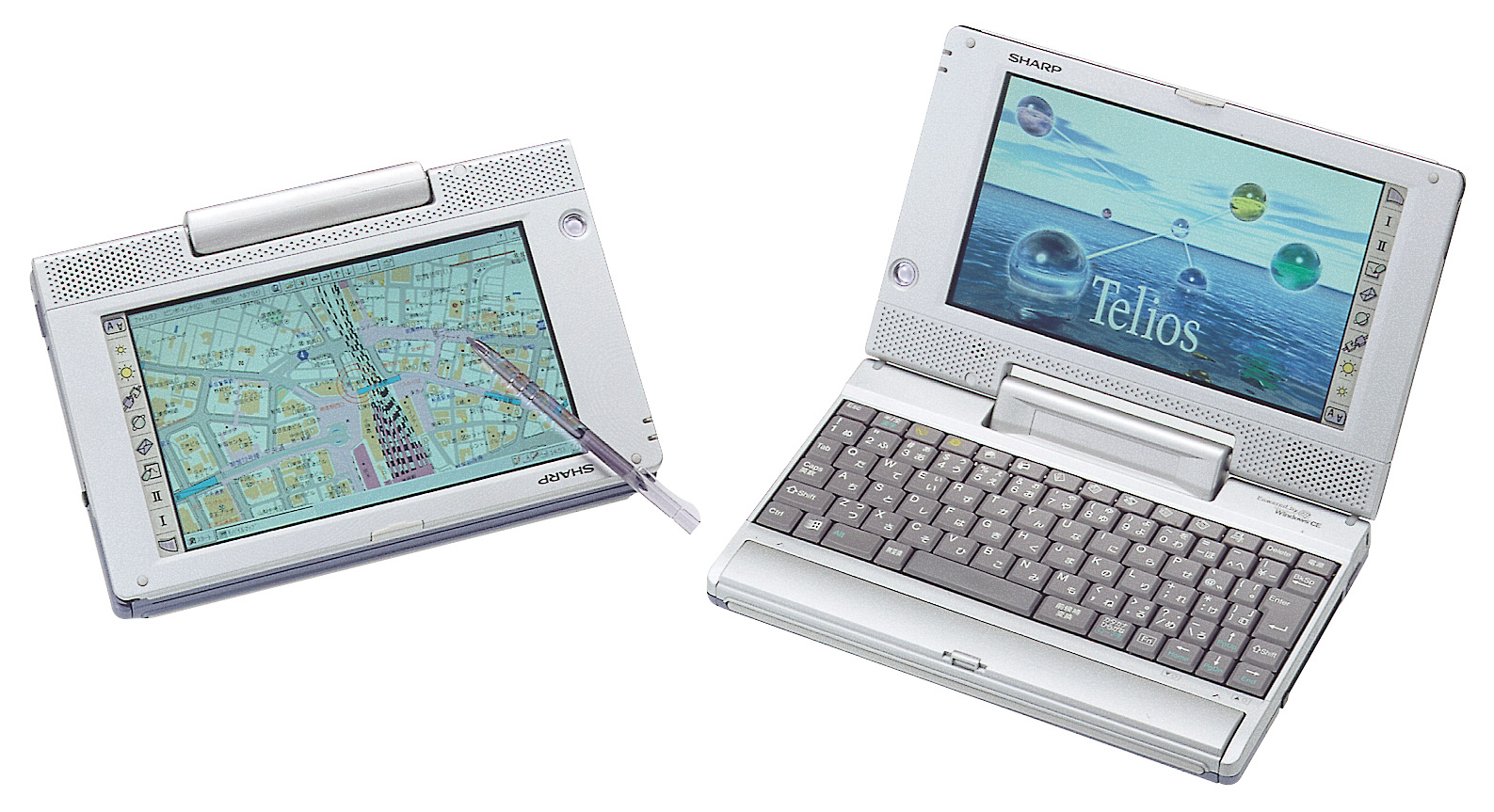
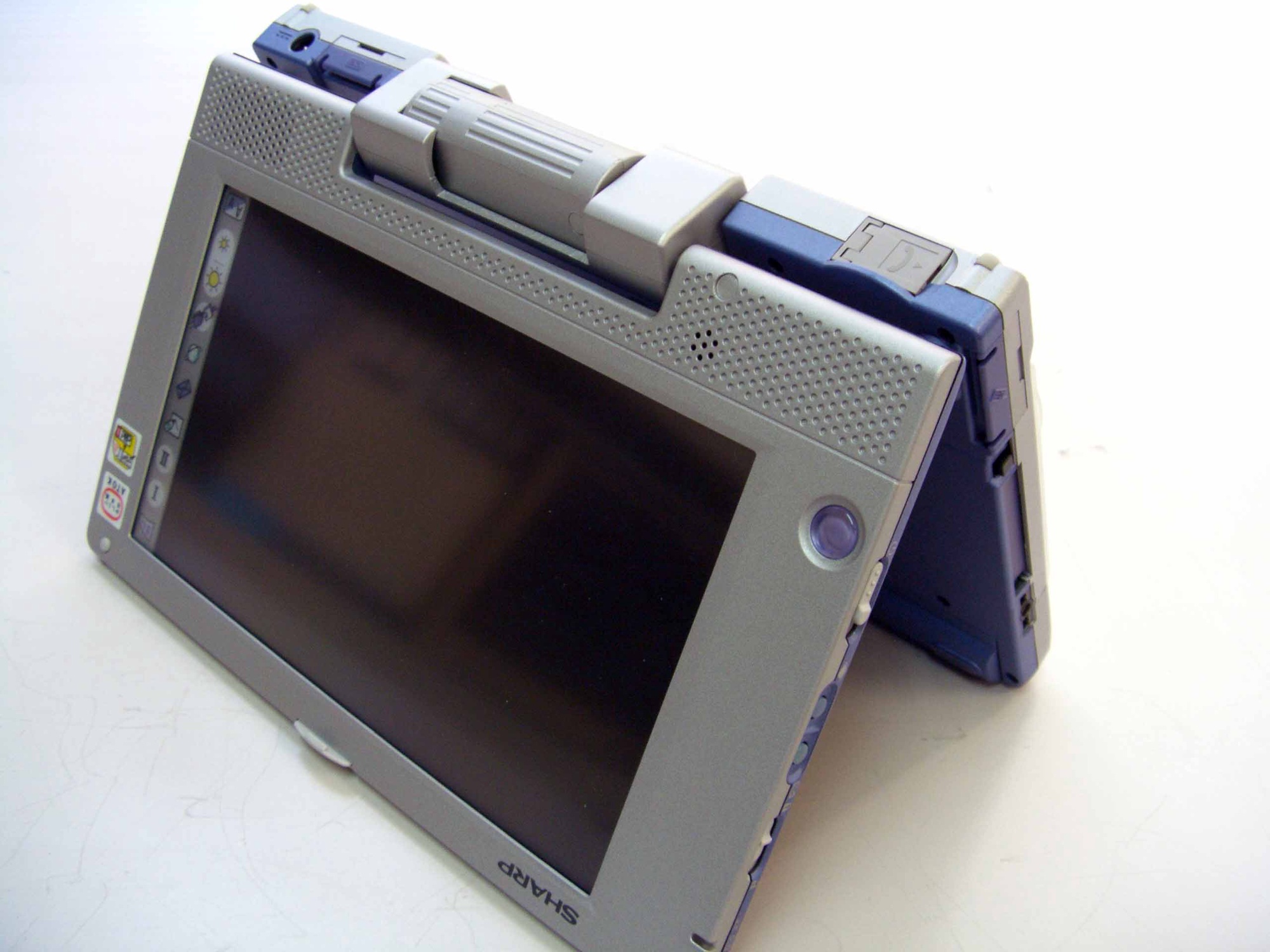
A particular novelty in the new Telios is the rotatable display, which can be folded back to transform the computer into a handy tablet allowing pen input with handwriting recognition.
But not only the display can rotate – so can the camera! The built-in digital camera uses a 350,000-pixel CMOS sensor and can take pictures even when the main unit is switched off. Its 180-degree rotatable optics allow the camera to point in different directions without moving the computer. The HC-7000 can only take still photographs, whereas the HC-VJ1C can also record video + audio**. Awesome, right? No other manufacturer offered such advanced tech in early 2000.
The Japanese VJs also gained a built-in digital mobile phone and PHS interface, allowing a compatible mobile phone to be connected to give the Telios internet access. It even has a dedicated "One Touch Email Receive Button" — you can press it with the lid closed and it will fetch your email, signalling that new messages have arrived by flashing a small LED. And the "One Touch Auto Surfing Button" lets you automatically download a pre-registered website so that you can browse it while offline.
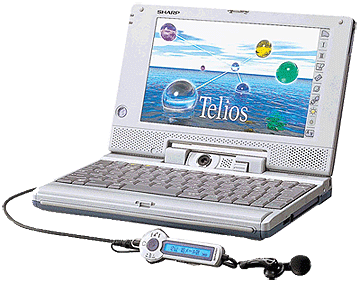
The optional remote control (CE-RE02) with a bright blue LCD, again only available in Japan, lets you see the sender, title, and body of emails, check your schedule, and control the MP3 player – in addition to controlling the Telios camera.
The Telios have a 79-key QWERTY keyboard and measure (W × D × H) 213 × 140 × 28.3 / 31.8 mm (HC-7000 and HC-VJ01 / HC-VJ2C).
* Market availability began in August 2000. The "January 2001" release date found for the HC-7000 on various databases is therefore incorrect.
** Up to one minute long, 320 × 240 px resolution, MPEG-4, G.726 audio codec.
Specifications
- Display: 7.1 inches, 800 × 480 px — Transflective TFT LCD
- CPU: Toshiba TMPR3922U — 129 MHz
- Rear camera:
- 0.35 MP CMOS, f/3.4
- 320 x 240 (HC-VJ only)
- Battery: 1800 mAh (removable)
- Operating system: Windows CE
- OS version at launch: 2.11
Advertisement
SHARP Telios VJ HC-VJ1C
- Waterproofing: None
- Dustproofing: None
- Operating memory (RAM): 32 MB
- Built-in storage memory: 24 MB
- External storage: PC Card Type I/II, CompactFlash Type I/II
It is possible to attach a GPS card to the Telios HC-VJ1C and display a map of the surrounding area in which the user currently is. To be able to download the map files, you need to connect a mobile phone or a PHS phone or use your landline's modem — a special connection cable is required.
SHARP Telios VJ HC-VJ1S
- Waterproofing: None
- Dustproofing: None
- Operating memory (RAM): 32 MB
- Built-in storage memory: 24 MB
- External storage: PC Card Type I/II, CompactFlash Type I/II
The Telios HC-VJ1S was a made-to-order business model intended for corporate customers.
Since it wasn't a consumer-oriented device, it had no camera. Are we here to do business or take photos?
SHARP Telios HC-7000
- Waterproofing: None
- Dustproofing: None
- Operating memory (RAM): 32 MB
- Built-in storage memory: 32 MB
- External storage: PC Card Type I/II, CompactFlash Type I/II
Although it was announced before the Japanese VJ-series, albeit by a couple of days, it took Sharp Europe five months to actually roll out the HC-7000.
Although the HC-7000 has the same physical dimensions as the HC-VJ1C, it weighs 820 grams – or 40 grams less. This difference might be explained by the absence of the digital mobile phone and PHS interface that its Japanese sibling has.
European articles about the HC-7000 do not mention the optional LCD remote control that was available for the Japanese model.
SHARP Telios VJ HC-VJ2C
- Waterproofing: None
- Dustproofing: None
- Operating memory (RAM): 32 MB
- Built-in storage memory: 32 MB
- External storage: PC Card Type I/II, CompactFlash Type I/II
The new instalment in the Telios VJ-series, the HC-VJ2C, was announced on 13 October 2000 and went into sale on 27 November – just two weeks after the HC-AJ3.
The main hardware difference is that it has 32 MiB of ROM, whereas the HC-VJ1C has 24 MiB.
Another difference is that the VJ2C has Windows CE 3.0 vs. CE 2.11 on the VJ1C.