Created: 28 June 2024 · Last edited: 27 September 2026
It's time for the Summer 2024 collection and we're expecting to see Sharp's latest flagship, the AQUOS R9. But something is missing: the Pro. Sharp has told us that there won't be an AQUOS R9 pro this year, leaving the R9 as the sole flagship in the summer collection. And while it's certainly a capable phone, it isn't quite what we've come to expect from Sharp's top-of-the-range R-series. Little did we know that Sharp wasn't quite finished with the idea of an R9 pro after all...
Both the AQUOS R9 and the AQUOS wish4 were announced as global models... well, at least the Japanese idea of "global", which rarely includes more than a few East-Asian countries. Anyway, the AQUOS R9 will be available to purchase in Taiwan, Singapore, and Indonesia, while the AQUOS wish4 will be sold in Taiwan and Singapore.
The AQUOS R9 is somewhat confusing. Does it qualify as high-end – judging by the display, camera and other hardware, yeah, it does – or does it qualify as upper mid-range – judging by the Snapdragon 7+ Gen 3 mobile platform that powers it? Let's call it somewhere in between.
Right, let's see why the next iteration of Sharp's AQUOS R series is worth (or not) our time and money.
Improvements over last year's model include advanced processing performance, a high-quality camera, powerful sound, and a brighter display, the press release says.
As I said, last year's AQUOS R8's Snapdragon 8 Gen 2 platform has been replaced by the lower-tier Snapdragon 7+ Gen 3, which is an octa-core processor with one core clocked at 2.8 GHz, three cores clocked at 2.6 GHz, and four cores clocked at 1.9 GHz. This is somewhat less powerful than last year's model, but we see a significant increase in the amount of RAM: while the R8 had 8 GB installed, the R9 has 12 GB (LPDDR5X) of physical and 8 GB of virtual RAM. Onboard storage is 256 GB (UFS 4.0), expandable using SDXC cards of up to 1 TB capacity.
Sharp says that it has improved the phone's cooling capacity further by installing a new vapour chamber that should come in handy for heat-intensive applications such as gaming and HD video content, as well as data-heavy downloads.
The AQUOS R9 has the now traditional Leica camera – a large 1/1.55-inch sensor and the Hector lens, which supports optical image stabilisation (OIS) and continuous autofocus subject tracking. The main sensor is 50.3 megapixels and has an aperture of f/1.9 (wide-angle, 85°; 23 mm equivalent), combined – as on last year's model – with electronic image stabilisation upgraded to optical. The secondary sensor is also 50.3 megapixels, but it is ultra-wide-angle and capable of shooting at 122° with a focal length equivalent to 13 mm. The aperture is f/2.2.
The video camera (standard camera only) has the advantage of hybrid image stabilisation (optical + electronic).
The front-facing camera has a 50.3-megapixel sensor with an f/2.2 lens (wide-angle, 84°; 23 mm equivalent). The AQUOS R8 had a measly 8 MP sensor. Selfie maniacs rejoice!
Sound-wise, the AQUOS R9 has the most powerful speakers ever installed on a Sharp phone. Curiously, the speakers are not installed exactly in the middle of either end, but one is almost at the edge, while the opposite one is more towards the centre of the housing. Each speaker is insulated in a box, separating it from the phone's internals and preventing sound interference from the other speaker. The phone now also supports Qualcomm's Snapdragon Sound feature, which lets you enjoy CD-quality sound even when using wireless headphones. That won't convince me – I remain a staunch supporter of cable-transmitted sound.
The display is, as usual for the flagships, a Pro IGZO OLED with a refresh rate of up to 240 Hz (120 Hz actual rate plus insertion of a black screen in between each frame). Sharp claims that the brightness has been increased significantly (to 1500 nit white brightness and 2000 nit peak brightness), making it easier to see even under bright sunlight. It is a 6.5-inch display with a resolution of 1080 x 2340 dots. Viewing experience is enhanced using Dolby Vision for the image and Dolby Atmos for the sound.
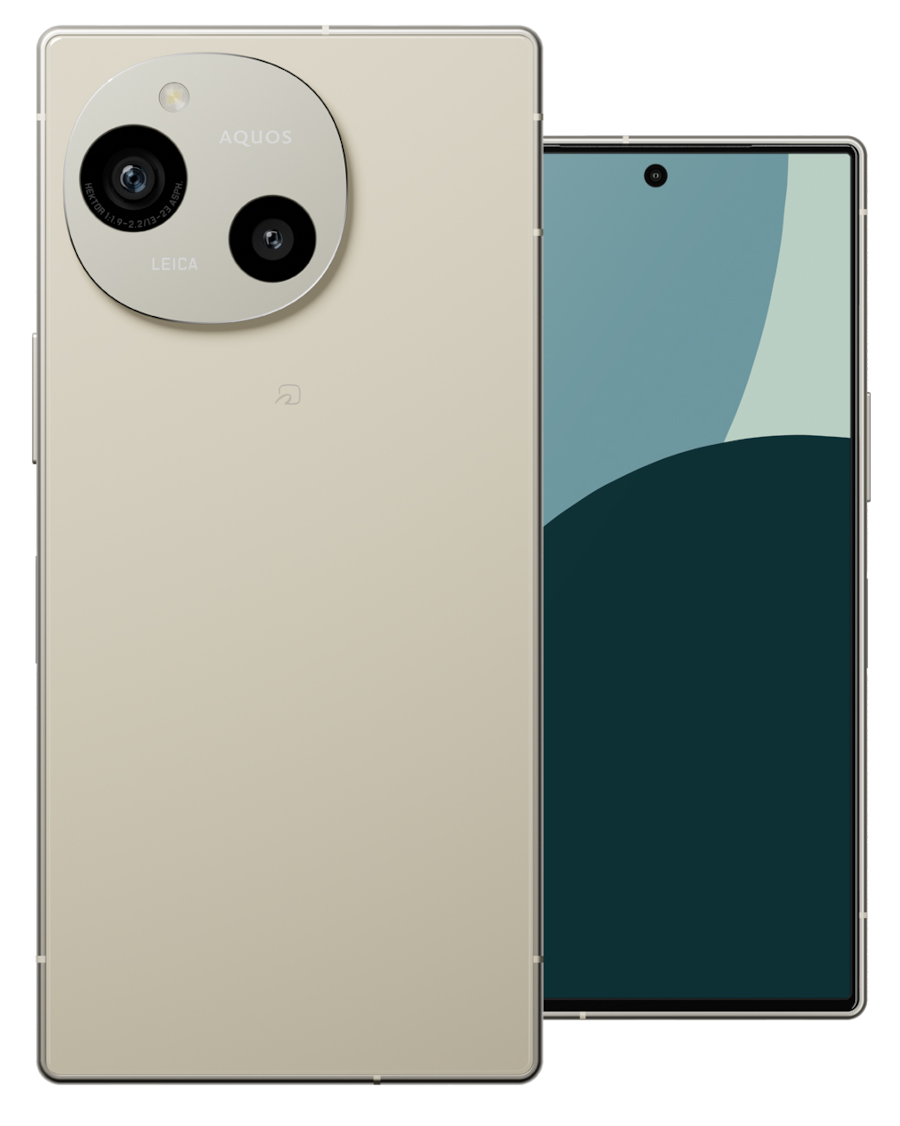
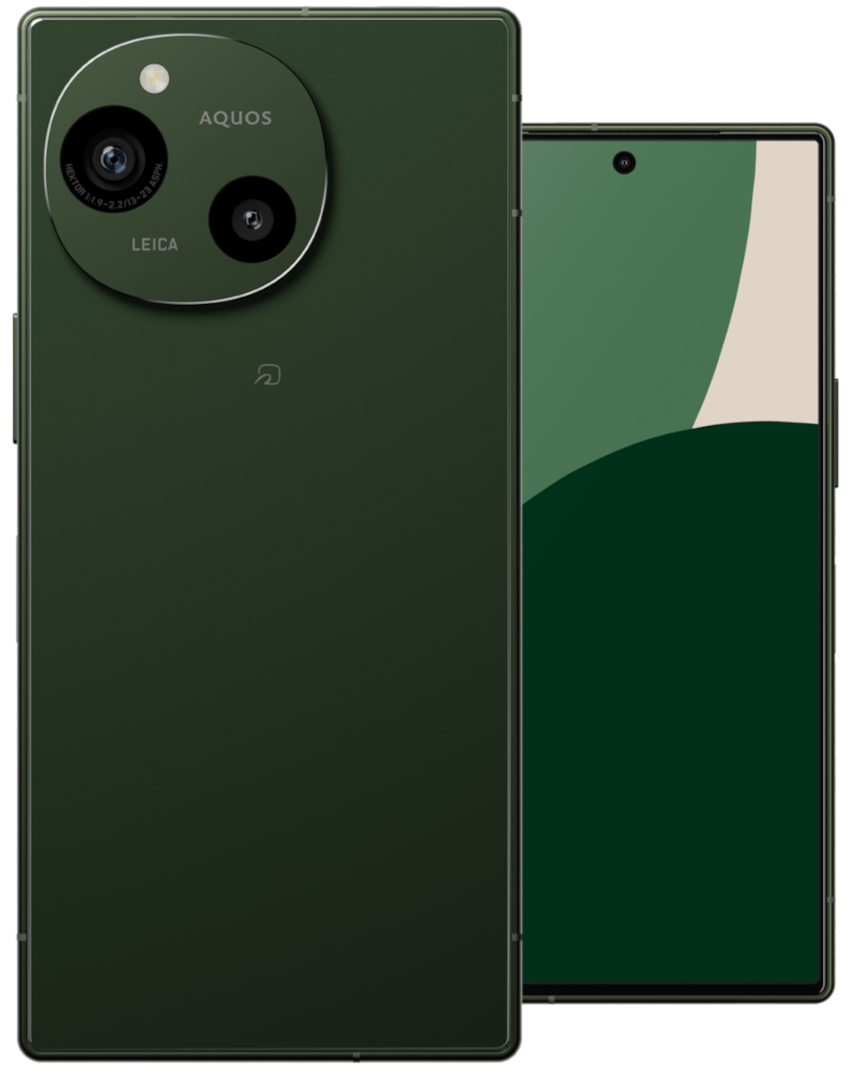
Now, the most obvious difference from last year's (and the year before that, and the year before that) is the new design, called "miyake design" by designer Kazunari Miyake. This combines simplicity and "presence" with an impressive "free curve" thingy around the cameras that is neither a circle nor a square. Well... okay.
The phone is also equipped with Sharp's first-generation AI that can summarise missed calls and function as an intelligent answering machine, letting you check call details at a glance without actually listening to the recording. We don't know if this only works in Japanese or also supports English. The earlier EMOPA prototypes only spoke Japanese.
The phone's back is made with Corning Gorilla Glass Victus 2 to ensure sturdiness, while the frame is made of recycled aluminium.
Faster wireless connectivity is ensured using the latest "be" standard in Wi-Fi (IEEE 802.11a/b/g/n/ac/ax/be). Bluetooth is in version 5.4.
Biometric authentication features the now-standard fingerprint and facial recognition (even when wearing a mask, which I find too spooky).
Both Japanese Osaifu-Keitai and standard NFC are supported, as usual.
The AQUOS R9 supports dual-SIM connectivity with one physical nanoSIM card and one virtual eSIM, with DSDV support.
The phone is waterproof, dust-proof, and shock-resistant (MIL-STD-810G/H).
The phone measures 156 x 75 x 8.9 mm and weighs about 195 grams. It is available in green or white.
The initial OS version is Android 14. Sharp is promising three OS upgrades and security updates for 5 years now.
Specifications
- Display: 6.5 inches, 2340 × 1080 px — Pro IGZO OLED / 1–240 Hz
- CPU: Qualcomm Snapdragon 7+ Gen 3 (SM7675) — 1 × 2.8 GHz + 4 × 2.6 GHz + 3 × 1.9 GHz
- Rear camera:
- 50.3 MP CMOS, OIS, PDAF, 85° wide-angle, f/1.9 + 50.3 MP CMOS, OIS, PDAF, 122° ultra-wide-angle, f/2.2
- 2160p @ 60 fps, OIS + EIS, 720p @ 240 fps slow motion
- Front-facing camera:
- 50.3 MP CMOS, EIS, AF, 84° wide-angle, f/2.2
- 2160 @ 30 fps, EIS
- Battery: 5000 mAh (non-removable)
- Operating system: Android
- OS version at launch: 14
Advertisement
 AQUOS
R9
SH-51E
- Waterproofing: IPX5/IPX8
- Dustproofing: IP6X
- Shock-resistance: MIL-STD-810H / MIL-STD-810H
- Operating memory (RAM): 12 GB physical + 8 GB virtual
- Built-in storage memory: 256 GB
- External storage: microSDXC, 1 TB
- The OS received an upgrade to version 15 on 5 June 2025.
- The OS received an upgrade to version 16 on 9 March 2026.
The Docomo models support the following radio communication frequency bands:
- 5G NR (FR1, FDD): n1/n3/n28
- 5G NR (FR1, TDD): n41/n77/n78/n79
- LTE (FDD): B1/B2/B3/B4/B5/B7/B8/B11/B12/B17/B18/B19/B21/B28
- LTE (TDD): B38/B39/B40/B41/B42
- W-CDMA: I/II/IV/V/VIII
- GSM: 850/900/1800/1900
 AQUOS
R9
A401SH
- Waterproofing: IPX5/IPX8
- Dustproofing: IP6X
- Shock-resistance: MIL-STD-810H / MIL-STD-810H
- Operating memory (RAM): 12 GB physical + 8 GB virtual
- Built-in storage memory: 256 GB
- External storage: microSDXC, 1 TB
- The OS received an upgrade to version 15 on 12 February 2025.
- The OS received an upgrade to version 16 on 11 March 2026.
The SoftBank model supports the following radio communication frequencies:
- 5G NR (FR1, FDD): n1/n3/n28
- 5G NR (FR1, TDD): n41/n77/n78/n79
- LTE (FDD): B1/B2/B3/B4/B5/B7/B8/B11/B12/B17/B18/B19/B21/B28
- LTE (TDD): B38/B39/B40/B41/B42
- W-CDMA: I/II/IV/V/VIII
- GSM: 850/900/1800/1900
 AQUOS
R9
SH-M28
- Waterproofing: IPX5/IPX8
- Dustproofing: IP6X
- Shock-resistance: MIL-STD-810H / MIL-STD-810H
- Operating memory (RAM): 12 GB physical + 8 GB virtual
- Built-in storage memory: 256 GB
- External storage: microSDXC, 1 TB
- The OS received an upgrade to version 15 on 17 February 2025.
- The OS received an upgrade to version 16 on 9 March 2026.
The Japan SIM-free version supports the following radio communication frequency bands:
- 5G NR: n1/n3/n5/n7/n28/n38/n40/n41/n66/n77/n78/n79
- LTE (FDD): B1/B2/B3/B4/B5/B7/B8/B11/B12/B13/B17/B18/B19/B20/B21/B28/B66
- LTE (TDD): B38/B39/B41/B42
- W-CDMA: I/II/IV/V/VIII
- GSM: 850/900/1800/1900
AQUOS
R9
SH-M28SG
- Waterproofing: IPX5/IPX8
- Dustproofing: IP6X
- Shock-resistance: MIL-STD-810H / MIL-STD-810H
- Operating memory (RAM): 12 GB physical + 8 GB virtual
- Built-in storage memory: 256 GB
- External storage: microSDXC, 1 TB
- The OS received an upgrade to version 15 on 25 August 2025.
- The OS received an upgrade to version 16 on 21 January 2026.
The Singapore version supports the following radio communication frequency bands:
- 5G NR: n1/n3/n40/n78
- LTE (FDD): B1/B3/B7/B8/B28
- LTE (TDD): B38/B40
AQUOS
R9
SH-M28TW
- Waterproofing: IPX5/IPX8
- Dustproofing: IP6X
- Shock-resistance: MIL-STD-810H / MIL-STD-810H
- Operating memory (RAM): 12 GB physical + 8 GB virtual
- Built-in storage memory: 256 GB
- External storage: microSDXC, 1 TB
- The OS received an upgrade to version 15 on an unknown date.
- The OS received an upgrade to version 16 on 12 May 2026.
The Taiwan version supports the following radio communication frequency bands:
- 5G NR: n1/n3/n7/n28/n38/n41/n78
- LTE (FDD): B1/B3/B7/B8/B28
- LTE (TDD): B38/B41
- W-CDMA: I/VIII
- GSM: 850/900/1800/1900
AQUOS
R9
SH-M28ID
- Waterproofing: IPX5/IPX8
- Dustproofing: IP6X
- Shock-resistance: MIL-STD-810H / MIL-STD-810H
- Operating memory (RAM): 12 GB physical + 8 GB virtual
- Built-in storage memory: 256 GB
- External storage: microSDXC, 1 TB
The Indonesia version supports the following radio communication frequency bands:
- 5G NR: n1/n3/n5/n8/n40
- LTE (FDD): B1/B3/B5/B8/B11
- LTE (TDD): B40
- W-CDMA: I/VIII
- GSM: 850/900/1800/1900