Created: 20 October 2026 · Last edited: 21 October 2026
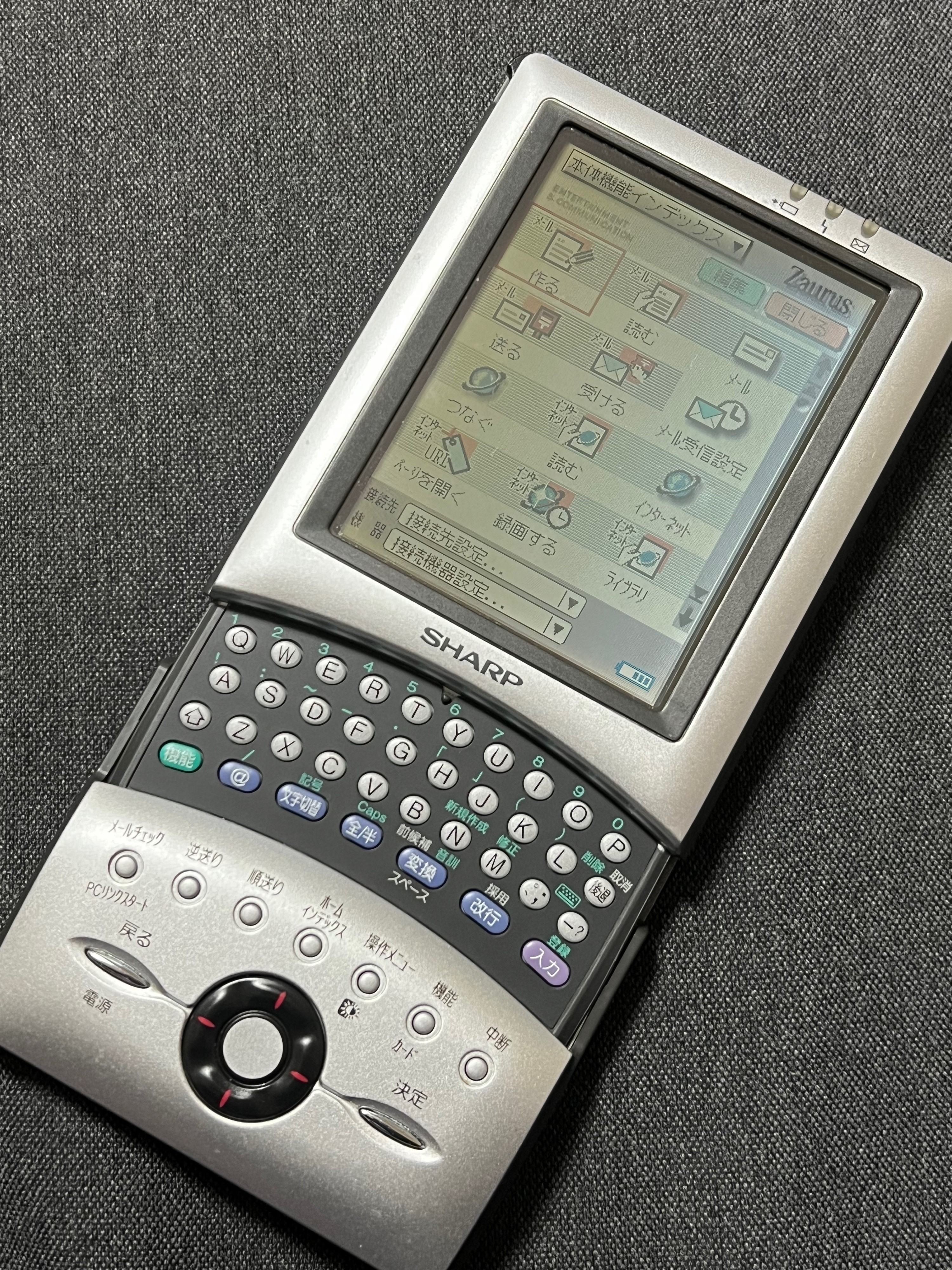
The MI-E1, released in December 2000, introduces a new physical design for the Zaurus. Instead of the traditional landscape layout, it uses a portrait-oriented 3.5-inch colour touchscreen with a resolution of 240 × 320 pixels and support for 65,536 colours. Its front-lit reflective TFT display remains readable under ambient light, with the built-in front light improving visibility in darker surroundings. Beneath the screen, a slide-out QWERTY keyboard provides a more convenient way to compose e-mails and enter text, while the touchscreen and stylus remain available for browsing and other tasks. The keyboard-equipped design would become the defining form of the final MI generation and carry over into the later Linux-based models as their traditional form factor.
The MI-E1 is also strongly oriented towards multimedia. It can play MP3 music and MPEG-4 video stored on memory cards, turning the PDA into a portable media player. Sharp offer the optional CE-VR1 MPEG-4 video recorder, which can record video and audio from external sources such as a television, VCR or camcorder onto a memory card for playback on the Zaurus. Video files can also be transferred from a computer, including recordings made with compatible digital camcorders. An optional remote control and headphones provide a more convenient way to listen to music.
The MI-E1 features both a CompactFlash Type II slot and an SD card slot, with support for MultiMediaCards (MMC) as well. The CompactFlash slot can accommodate communication accessories such as NTT DoCoMo's P-in Comp@ct data-card PHS terminal, enabling mobile Web browsing and e-mail. However, the two memory-card slots generally can not be used simultaneously, although certain combinations involving the P-in Comp@ct are supported. The device has 16 MB of built-in memory, including 8 MB of flash memory, but only around 3.6 MB is initially available for user files and data because the system and pre-installed software occupy part of it.
I have been unable to identify the exact processor model used in the MI-E1 / MI-L1 but contemporary publications specify a 120 MHz clock. It is most likely the SH7709A (SH-3 family) or the SH7729 (SH3-DSP family).
Despite its multimedia capabilities, the MI-E1 remains a practical personal organiser, combining scheduling, contacts, notes and e-mail with Web browsing. Measuring approximately 81.5 × 139.5 × 17 mm and weighing around 200 g with its battery and stylus, it packs a keyboard, colour touchscreen and two expansion slots into a compact handheld device. By bringing text entry, mobile communication and media playback together, Sharp gave the Zaurus a distinctly more entertainment-oriented character without abandoning its role as a pocket-sized productivity tool.
Photo: https://note.com/akiox/n/n694192d5ea57
Specifications
- Display: 3.5 inches, 320 × 240 px — Front-Lit Reflective TFT LCD
- CPU: Hitachi SH7709A — 60 MHz
- Operating system: Zaurus OS
Advertisement
Zaurus MI-E1 MI-E1
- Waterproofing: None
- Dustproofing: None
- Operating memory (RAM): 8 MB
- Built-in storage memory: 8 MB flash
- External storage: CF Type II, SD/MMC
Zaurus MI-E1 MI-L1
- Waterproofing: None
- Dustproofing: None
- Operating memory (RAM): 8 MB
- Built-in storage memory: 8 MB flash
- External storage: CF Type II, SD/MMC
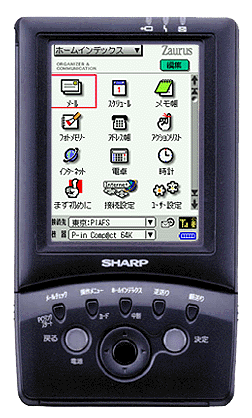
The MI-L1, released in late May 2001, is a business-oriented version of the keyboard-equipped MI design. It retains the MI-E1's 3.5-inch reflective TFT colour touchscreen (240 × 320 pixels, 65,536 colours), slide-out keyboard, and SD/MMC and CompactFlash card slots, but omits the front light and the hardware and software required for MP3 music and MPEG-4 video playback. Removing these components reduces its weight by approximately 15 g, to around 185 g without the protective cover. The matte-black finish and revised, more practical button layout further distinguish it from the consumer-oriented MI-E1.
Rather than multimedia, the MI-L1 focuses on business productivity and PC integration. Its Web browser can switch between portrait and landscape orientations, while the built-in Memo application supported integration with Microsoft Outlook. It can also display documents converted from Microsoft Word and Excel files and exchange data with the Cybozu Office 4 groupware suite. Sharp introduced the optional CE-ST5 cradle, which allows the device to charge and communicate with a PC through a single dock connection. These changes make the MI-L1 a more business-focused alternative to the MI-E1, while retaining the compact keyboard-equipped design that defines this generation of Zaurus.
The MI-L1 supports a wide range of optional accessories, including the CE-AG06 350,000-pixel digital camera card, a 56-kbit/s CompactFlash modem card, and SD and CompactFlash memory cards. For connectivity, optional cables supports mobile phones, cdmaOne and several PHS systems, while PC synchronisation is available through a USB connection kit or an RS-232C cable, with the optional CE-ST5 cradle providing a convenient desktop dock.