Created: 11 October 2026 · Last edited: 12 October 2026
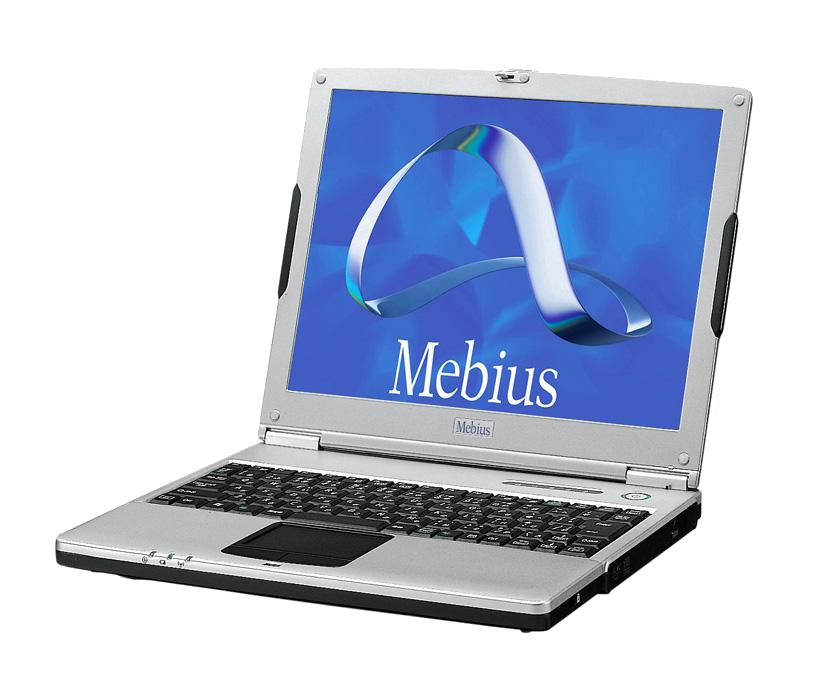
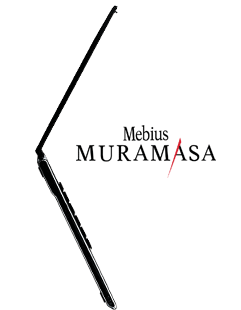
It took Sharp three years after the Mebius Note PC-PJ1 to build the world's thinnest and lightest notebook with a 12.1-inch display. Announced on 17 May 2001, it was the Mebius Muramasa PC-MT1-H1. The notebook's nickname celebrates Japan's famous swordsmith Muramasa – its thin, sharp-looking design evoked a Japanese sword.
The first Muramasa measured 282 × 232 × 16.6–19.6 mm and weighed 1.31 kg.
To achieve such low weight and thinness, Sharp removed the conventional frame that supported the LCD and used the metal display mask and cover to provide structural support. The display cover was made of magnesium alloy, while the display mask and upper and lower body panels were made of aluminium alloy. Inside, a magnesium frame with a box-like lattice structure reinforced the chassis. In addition, opening the display mechanically raised the key tops, allowing 3 mm of key travel despite the unusually thin chassis. The keyboard had an 18 mm key pitch. This was a central part of the design, not merely a cosmetic feature.
The Muramasa was powered by an Intel Mobile Pentium III 500 MHz processor, down-clocked to 300 MHz when running on battery power, allowing the notebook to last about 3.5 hours. You could opt for the large-capacity battery, which would extend battery life to about 10 hours, but then it would no longer be the world's lightest notebook.
The installed RAM amounted to 128 MB (fixed and non-upgradable). There was also a 20 GB HDD, an ATI RAGE Mobility-M graphics adapter with 4 MB of video memory, and a CompactFlash Type II slot.
The display had a special anti-reflection coating to reduce reflections from ambient light, making the screen easier to see in bright surroundings while improving perceived black levels and colour contrast. Sharp had introduced this technology the previous year in its notebooks and was now, in 2001, offering it across several notebook lines. The Muramasa had a 12.1-inch LCD with XGA resolution (1024 × 768 pixels), capable of reproducing 16.77 million colours using dithering.
The Muramasa name endured as the name of its own notebook line after the original 2001 model. The ultra-thin and lightweight range included two more variants of the PC-MT1 generation, followed in 2002 by the PC-MT2, which featured built-in Wi-Fi, more memory, a higher-clocked processor, more video memory and other improvements. In 2003, the PC-MM1 series emerged with a docking cradle that allowed its hard drive to be used as an external USB drive. A curious little model was released in 2004 that deserves its own article: the CV50F. And in 2005, the last Muramasa notebooks rolled out under the PC-MR series name: the PC-MR80H, PC-MR50H and PC-MR8BH7. These had either a Celeron M 350J or a Pentium M 730 processor, both clocked at 1.6 GHz, 256 MB of RAM (upgradable to 768 MB), a 60 GB HDD and a DVD drive. They weighed 1.75 kg, significantly more than the first Muramasa.
Specifications
- Display: 12.1 inches, 1024 × 768 px — Low-Reflection Black TFT LCD
- CPU: Intel Mobile Pentium III (Coppermine) — 500 MHz
- Operating system: Windows
- OS version at launch: Me
Advertisement
SHARP Mebius MT1 PC-MT1-H1
- Waterproofing: None
- Dustproofing: None
- Operating memory (RAM): 128 MB
- Built-in storage memory: 20 GB
- External storage: CompactFlash Type II
The Muramasa PC-MT1-H1 was priced at 200,000 Yen, which equalled US$1,642. The PC-MT1-H1S variant, which included a pre-installed Office XP, selling for 220,000 Yen or $1,806.
SHARP Mebius MT1 PC-MT1-H3
- Waterproofing: None
- Dustproofing: None
- Operating memory (RAM): 192 MB
- Built-in storage memory: 20 GB
- External storage: CompactFlash Type II
The second model in the Muramasa series came just four months after the first. It featured the same Pentium III processor only now clocked at 600 MHz. The amount of RAM was increased by 50%. The installed OS was now Windows XP Home edition.
SHARP Mebius MT1 PC-MT1-H5
- Waterproofing: None
- Dustproofing: None
- Operating memory (RAM): 256 MB
- Built-in storage memory: 30 GB
- External storage: CompactFlash Type II
The PC-MT1-H5 is the third iteration of the Muramasa series. It came with an upgraded Pentium III-M processor clocked at 750 MHz, more RAM and more built-in storage, and ran Windows XP.
A "downsized" PC-MT1-H5R variant was also launched which swapped the processor with the ultra-low-voltage mobile version Celeron 650 MHz and had a 20 GB HDD.