Created: 11 October 2026 · Last edited: 12 October 2026
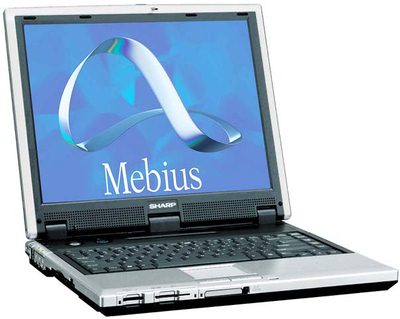
The year is 2003, and this is the world's first 3D laptop – and one that doesn't require glasses! The second glasses-free 3D laptop, the Toshiba Qosmio F755, came out in 2011, following two attempts by Acer and ASUS in 2009 that did require glasses.
In 2002, Sharp released the first of its experiments in glasses-free 3D displays: the Sharp mova SH251iS flip phone, whose 2.2-inch, 176 × 220-pixel screen could switch between 2D and 3D. In June the following year, the Sharp mova SH505i followed, with an improved 2.4-inch, 240 × 320-pixel screen. It continued the glasses-free 3D approach, making the effect more useful for viewing images on a phone.
In October 2003, Mebius Note PC-RD3D (Japan), better known as the Sharp Actius RD3D laptop (USA), was released. Its 15-inch, 1024 × 768-pixel TFT LCD display could switch between 2D and 3D modes at the press of a button.
For its mobile phones, Sharp had developed a compact and lightweight solution – a conventional TFT LCD combined with a special liquid-crystal layer that forms a parallax barrier. That wasn't the case with the laptop. The RD3D had not one but two physical LCD panels stacked one behind the other, with a parallax barrier between them, which helps explain its ginormous weight of over 4.5 kg and exorbitant price of $3,299. Here's how PCMag described the technology:
To render 3-D images, the system uses two 15-inch LCD panels that sandwich a parallax barrier (parallax refers to the difference between what your left and right eyes see, which the brain interprets as 3-D). The front panel is a standard Sharp 15-inch XGA (1,024-by-768) color display. In 2-D mode, only this panel is active.
The rear panel is a monochrome-only unit that provides 3-D information. One image is created from pixels 1, 3, 5, 7 and so forth up to pixel 1,023 for the left eye, while the right eye sees pixels 2, 4, 6, and so on, through 1,024. The two panels, the parallax barrier, and the light path through them are aligned to work best when a viewer is about 21 inches back from the display and perfectly centered.
I can't really say how well this worked to create the glasses-free 3D effect, but many users were amazed – while others were not, with some even complaining of headaches and distorted vision. It was over nine years later that Sharp released another glasses-free 3D smartphone, the AQUOS Phone SH-01D, which I owned and enjoyed tremendously. The 3D effect was indeed spectacular.
But let's see what else the Mebius Note/Actius RD3D had to offer in terms of computing. It was powered by a 2.8 GHz Pentium 4 processor, aided by an NVIDIA GeForce4 440 Go graphics controller, and had 512 MB of RAM (upgradable to 1 GB) – fairly decent specs for the time. It also had a 60 GB, 4,200-rpm Fujitsu HDD.
It was a strange decision for Sharp to remove the Wi-Fi module from the RD3D, considering that the conventional RD20 had one, along with a faster 3.06 GHz processor.
As mentioned above, the RD3D was hardly lightweight, weighing a staggering 4.63 kg. But the conventional (non-3D) RD20 weighed even more, at 4.72 kg. Neither machine was particularly well suited to being carried around, and the poor battery life and mediocre wireless performance (according to PCMag) didn't help. But the RD3D wasn't light on the wallet, either: its initial price of $3,299 was soon reduced to $2,999, but that was still $1,300 more than the price of the conventional RD20. And it didn't even have built-in Wi-Fi (this needs to be repeated) – you had to use the PC Card slot to add it.
Specifications
- Display: 15.0 inches, 1024 × 768 px — TFT 3D LCD
- CPU: Intel Pentium 4 (Northwood) — 2.8 GHz
- Operating system: Windows
- OS version at launch: XP
Advertisement
SHARP Mebius RD3D PC-RD3D
- Waterproofing: None
- Dustproofing: None
- Configuration 1: Operating memory (RAM) 512 MB, Built-in storage memory 60 GB, External storage PC Card Type II, CF Type II, SD/MMC, Memory Stick
- Configuration 2: Operating memory (RAM) 1 GB, Built-in storage memory 60 GB, External storage PC Card Type II, CF Type II, SD/MMC, Memory Stick