Created: 11 October 2026 · Last edited: 18 October 2026
To demonstrate how quickly mobile computers evolved back in those days is the Mebius Wide PC-W100 (and the PC-W100D variant) that launched in September/October 1996 (announced 27 August), less than a year after the first Mebius (there were quite a few models in between).
As the nickname "Wide" suggests, this laptop computer has a wide screen format, and it is the world's first colour widescreen notebook. Indeed, at least one notebook-sized computer had a wide screen format before this, the Compaq LTE (1989), but it was not what we now understand as "widescreen" (16:9 or similar). And to my knowledge none had a colour widescreen display. The LCD on the Compaq LTE had a ~2.1:1 ratio (about 19:9) and was monochrome (four shades of grey). Its display ratio appears to have been the result of compromises between weight, price, battery life, and ability to show rudimentary graphics, not an intentional decision to conform to cinematic and television picture standards like in Sharp's case.
The new 16:9 format uses a slightly shorter screen vertically, 11.2", but has a higher resolution of 1024 × 600 pixels. The TFT display variant, PC-W100, rolling out on 10 September, features one more significant advancement: the display is now capable of reproducing 262,144 colours (18-bit). For those who didn't want to shell out the extra 110,000 Yen (~US$1,000), Sharp also released a DSTN display variant on 1 October that cost 370,000 Yen (approx. US$3,350).
The PC-W100 offered one more significant improvement: it weighs 2.1 kilograms, whereas the AV1 from the year before had the whooping 3.3 kg! Now, that's more like something you actually can put on your lap, without suffering muscle cramps shortly after. The weight loss is certainly connected to the decision to ditch the CD-ROM and leave only the floppy disk drive.
The Mebius Wide did evolve in terms of power, too. It used the same Intel Pentium P54C processor, only now clocked at 133 MHz (double the frequency of the lower AV1 model). The processor had 16 KB of built-in cache, supplemented by a further 256 KB of high-speed cache memory to improve performance. RAM was again 16 MB, expandable to 32 MB, but now there was 2 MB of dedicated video memory.
The PC-W100 offered high-speed (4 Mbps) infrared data transfer and, in US and Canadian versions, a built-in 28.8 kbps modem for dial-up Internet access, faxing and voice communication. Its two PCMCIA Type II slots also allowed compatible expansion cards to be added.
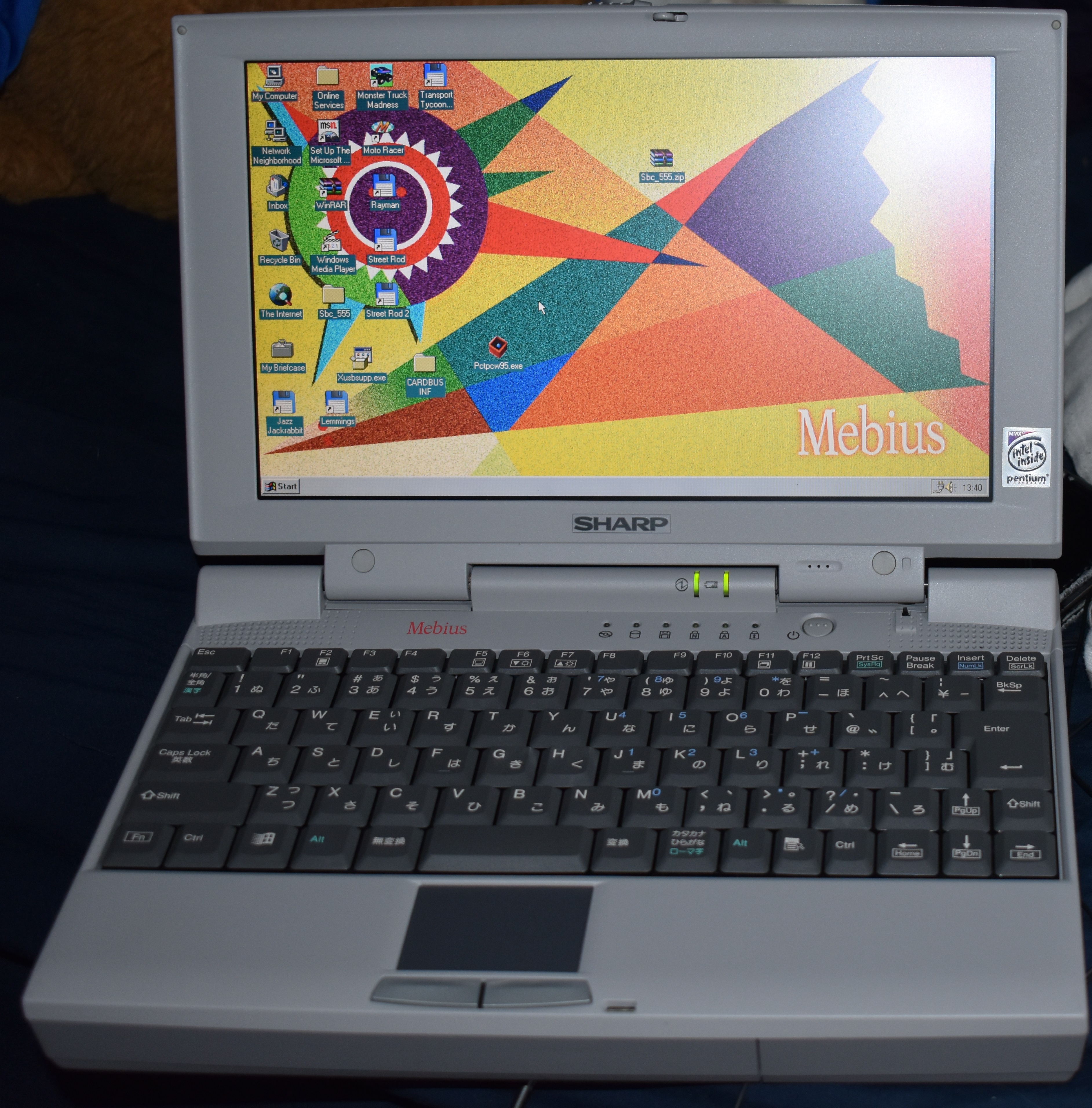
The image depicts the Mebius MN-W30-X13 released in July 1997. I have used that because no decent side real photos of the PC-W100 seem to exist and this model is almost identical in chassis to it (the differences are internal). Photo by Lukeno94, Reddit.
Specifications
- Display: 11.2 inches, 1024 × 600 px — TFT LCD
- CPU: Intel Pentium (P54C) — 75 MHz / 90 MHz
- Operating system: Windows
- OS version at launch: 95
Advertisement
SHARP Mebius Wide PC-W100
- Waterproofing: None
- Dustproofing: None
- Operating memory (RAM): 16 MB
- Built-in storage memory: 1 GB
- External storage: None
The PC-W100 display could reproduce 262,144 colours (18-bit), which was a significant advancement at the time but this added $1,000 to the $3,350 price of the "standard" model.
SHARP Mebius Wide PC-W100D
- Waterproofing: None
- Dustproofing: None
- Operating memory (RAM): 16 MB
- Built-in storage memory: 1 GB
- External storage: PC Card Type II
If you didn't care about the better display and 65,536 colours was just fine for you, the PC-W100D was the choice for you – and it cost you $1,000 less.