Created: 4 February 2012 · Last edited: 8 September 2026
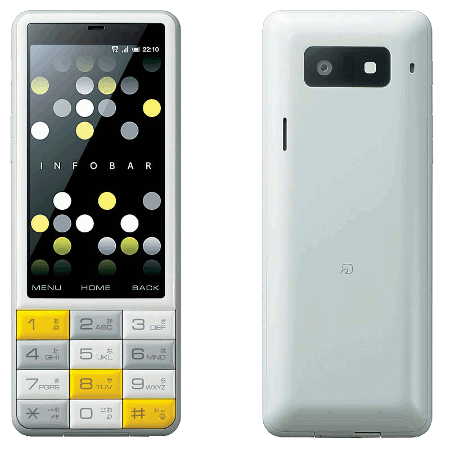
Japanese carrier AU KDDI added a rather unusual smartphone to its stylish INFOBAR series in early 2012: the IIDA INFOBAR C01, code-named SHX12. While the previous year's INFOBAR A01 was a conventional full-touch smartphone, the C01 went back to the series' roots with a compact bar-shaped body and a physical 12-key keypad inspired by the original INFOBAR feature phone.
The C01 was designed by renowned Japanese product designer Naoto Fukasawa, who had also designed the earlier INFOBAR models. In fact, the "C" in C01 stands for Classic, reflecting its deliberate return to the traditional INFOBAR form. Its distinctive keypad uses the familiar INFOBAR tile-like design, while the narrow 52 mm body makes the phone particularly comfortable to operate with one hand.
The phone has a 3.2-inch FWVGA (854 × 480) TFT LCD touchscreen. Below it sits the 12-key keypad, comprising the usual numeric keys plus * and #. Unlike many contemporary Japanese phones, however, there is no physical four-way navigation pad or dedicated call/end-call keys; the MENU, Home and Back controls are capacitive buttons below the display, while calling is primarily handled through the touchscreen.
The INFOBAR C01 runs Android 2.3 with Sharp's customised iida UI, inherited and adapted from the INFOBAR A01. The interface retains its distinctive vertically arranged, tile-like design, but the C01 also makes use of the physical keypad: numbers can be dialled directly from the home screen, and long-pressing the number keys can be assigned to launch applications.
Inside is a single-core Qualcomm Snapdragon S2 MSM8655T processor running at 1.4 GHz, accompanied by 512 MB of RAM and 4 GB of internal storage. The latter was a substantial increase over the 2 GB found in the INFOBAR A01, although only around 1 GB was actually available for applications and user data. Storage can be expanded with a microSDHC card of up to 32 GB; a 2 GB card was supplied with the phone.
The rear camera is an 8.04-megapixel CMOS unit with autofocus and is capable of recording HD video. There is no front-facing camera.
Despite its small size, the C01 is packed with the usual Japanese-market smartphone features, including Wi-Fi 802.11b/g/n, Bluetooth 3.0 + EDR, infrared communication, FeliCa-based Osaifu-Keitai mobile wallet and One Seg digital TV. It also supports DLNA for sharing multimedia with compatible devices. Global Passport provides international roaming over CDMA, GSM and GPRS networks.
The phone is powered by a rather modest 1,020 mAh battery, giving it approximately 370 minutes of talk time and 350 hours of standby time. There is no waterproofing, and unusually for a phone of this era, there is no built-in 3.5 mm headphone jack either; a microUSB-to-3.5 mm adapter was supplied instead.
The INFOBAR C01 measures approximately 52 × 130 × 12.3 mm (W × H × D), with a maximum thickness of about 12.5 mm, and weighs just 106 grams. It was available in three instantly recognisable INFOBAR colours: NISHIKIGOI, ICHIMATSU and the new KIIRO.
Although the C01 is technically a smartphone, its designers clearly wanted it to feel more like a classic Japanese mobile phone. The physical keypad, narrow body and colourful tile-like buttons make it a fascinating halfway point between the traditional INFOBAR and the emerging Android smartphone era.
Specifications
- Display: 3.2 inches, 854 × 480 px — New Mobile ASV LCD
- CPU: Qualcomm Snapdragon S2 (MSM8255T) — 1.4 GHz
- Rear camera:
- 8.04 MP CMOS, AF, SR
- 720p @ 30 fps
- Battery: 1020 mAh (removable)
- Operating system: Android
- OS version at launch: 2.3
Advertisement
 iida
INFOBAR C01
SHX12
- Waterproofing: None
- Dustproofing: None
- Operating memory (RAM): 512 MB
- Built-in storage memory: 4 GB
- External storage: microSDHC, 32 GB
The IIDA INFOBAR C01 went on sale in Japan on 3 February 2012.
Watch a video presentation of the IIDA INFOBAR C01 here: YouTube.