A Tumultous Smartphone Market in 2024
Created:
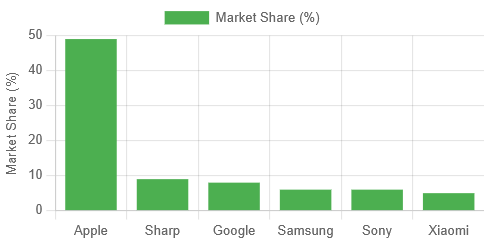
In 2024, Sharp continue their... ahem, unrivalled Android smartphone market share. It's fairly rivalled, actually – starting in 2023, Google and their Pixel series have been a close second.
Of course, the overall smartphone market is still dominated by Apple's iPhones and there's no end to this in sight. Apple held a 49% share in 2024 but this is a drop from the nearly 52% in 2023.
This happened against a bullish market: 32.4 million units were sold in 2024, which is a 7% YoY growth from 2023 but still two million units less than sold in 2022.
The total number of Android devices shipped in 2024 is 16.5 million, which represents a 1.9% growth from the 14.6 million units in 2023. This growth is clearly fuelled by Sharp and Xiaomi alone, with all other brands losing or barely keeping their grounds.
Sharp ranked second and held 9% of the smartphone market and 17.6% of the Android market. This is the only Japanese brand to have experienced sales growth in 2024. Such growth appears to have been fuelled by the mid-range Aquos devices (the Aquos wish3 and the Aquos wish4, the Aquos sense8 and the Aquos sense9, and possibly also the Aquos R9 – not the R9 pro). Maybe this is why the Aquos R10 pro is yet to be announced in late October 2025?
Google came out second in the Japanese Android market with 15.7% share (and an 8% share of the overall smartphone market) but is seeing a 1% decline.
Sharp and Sony combined held 15% of the overall smartphone market, with a noticeable year-on-year decline: while Sharp have made gains, Sony have accumulated losses.
This said, Sony ranked fourth in the Android market with an 11.8% share – the third place occupied by Samsung, with the same 11.8% share but slightly better sales.
2024 has brought one more surprise: Xiaomi has also shipped 11.8% of all Android smartphones in Japan. I certainly expect it to outperform Sony in 2025 and maybe also beat Samsung in the race for the third place.
Source: Counterpoint Research.
Advertisement