Sharp Develops a Display That Doesn't Look Like a Display
Created:
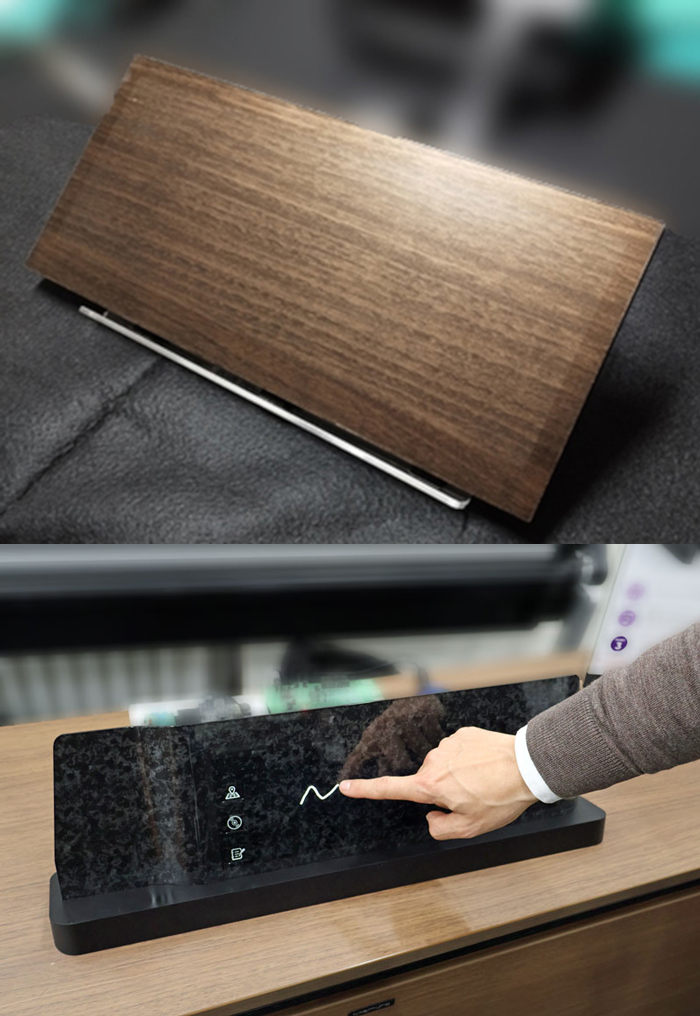
Sharp has come up with a rather clever way of dealing with one of the less glamorous problems created by our increasingly screen-filled lives: what to do with the screen when it isn't being used.
The company's new Texture Display is designed to disappear into its surroundings when switched off. Instead of leaving the familiar black rectangle sitting in the middle of a dashboard or other piece of furniture, it can look like wallpaper, wood grain or another decorative surface. Switch it on, however, and it becomes a conventional bright, full-colour display.
Sharp presented the technology as part of its Next-Generation Automotive Cockpit Solution, a concept developed around the idea of making future car interiors feel less like the cockpit of a machine and more like a comfortable living room. The company first showed the concept at its SHARP Tech-Day'24 Innovation Showcase in September 2024, and subsequently provided more details about the technology in May 2025.
A screen hiding in plain sight
The principle behind Texture Display is surprisingly straightforward. A specially printed, plate-like texture panel made from material such as film or glass is placed over an LCD panel. When the LCD is switched off, the printed surface is visible, giving the panel the appearance of an ordinary decorative material. When the LCD is switched on, light passes through the printed panel and the screen underneath produces the image.
This allows the appearance of the panel to be customised to suit its surroundings. In a car, for example, it could be made to resemble the dashboard trim, wood grain or another interior finish. When there is nothing to display, there is no big black screen demanding attention.
When required, the same surface can display driving information, navigation, climate controls, audio controls or other information. Sharp's concept even allows the display to be combined with its Click Display technology, which provides tactile feedback so that controls can feel more like physical buttons.
The difficult bit is getting the light through
Of course, putting a printed pattern in front of a display creates a rather obvious problem: the pattern gets in the way of the picture.
Sharp says it experimented with different inks and printing techniques to find a structure that could retain the appearance and texture of wallpaper while allowing enough light through for a high-quality display. During development, the company encountered colour shifts and situations where the printed pattern remained visible over the displayed image. Improvements to the ink and printing patterns helped solve these problems.
The result is a claimed transparency of approximately 70%. Sharp describes this as an industry-leading figure as of May 9, 2025, according to its own research.
That transparency is particularly important in a vehicle. Car displays have to compete with considerably more ambient light than a typical indoor display, so they need to be bright. A highly transparent surface allows more of the LCD's light to pass through, making it possible to achieve higher brightness without simply throwing more power at the backlight.
Sharp also points out that higher transparency can reduce power consumption and heat generation. That is useful in a car, where both energy efficiency and the amount of heat generated inside the cabin matter.
Beyond the car
Although Sharp is currently demonstrating Texture Display in an automotive application, the technology is not limited to cars. The company says it could also be used in home electronics and is continuing development with the aim of early commercialisation.
A television could, for example, disappear into a decorative wall when switched off, while a kitchen appliance could have controls that only become visible when needed. The same principle could be applied to other electronic devices where a permanently visible black screen would be undesirable.
Texture Display is still a development technology rather than a mass-market Sharp product, so it remains to be seen where it will eventually appear. But after decades of making displays larger, thinner, brighter and more sophisticated, Sharp is exploring another direction: making the display itself disappear when there is nothing to display.
Source: SHARP Blog, “What Is Texture Display That Blends Seamlessly into Interior Design? – Part 2 of Our Introduction to the Next-Generation Automotive Cockpit Solution”, 16 May 2025.
Advertisement