Sharp's Smartphone Market Share Takes a Beating in 2025
Created:
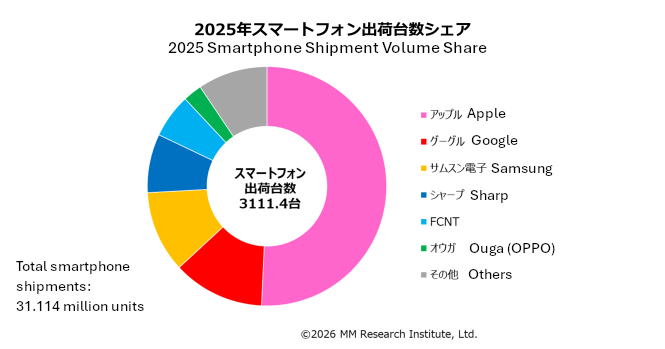
Sharp's Japanese smartphone market share has taken a rather unpleasant turn in 2025. After climbing to 9% in 2024 and briefly looking as though it might be staging a proper comeback, Sharp has slipped to fourth place among smartphone manufacturers – or third among Android manufacturers.
And, yes, this time there is no clever wording around it: Sharp lost ground.
Japan's smartphone market itself had a good year. According to MM Research Institute (MMRI), 31.114 million smartphones were shipped in Japan in 2025, an 11.6% increase over 2024. So this isn't a case of everybody falling into a hole and Sharp merely falling slightly less far. The market grew, while Sharp's relative position deteriorated.
Apple, naturally, continues to behave as though the Japanese smartphone market was invented specifically for it. The iPhone accounted for 50.7% of all smartphone shipments in 2025, keeping Apple above the psychologically important 50% mark for the third consecutive year. Apple shipped 15.782 million units, up 12.1% from the previous year.
But the more interesting part is what happened behind Apple.
Google took second place with 12.1%, followed by Samsung with 10.7%. And then comes Sharp, with 7.8%.
Yes, our beloved Japanese display-and-camera-and-occasionally-questionable-marketing specialist is now fourth.
Sharp shipped 2.497 million smartphones in 2025, giving it a 7.8% share of the Japanese smartphone market. Google shipped 3.854 million, while Samsung shipped 3.433 million. Sharp therefore trails Google by about 1.36 million devices and Samsung by about 936,000.
The 2024 figures make the deterioration rather more painful. Counterpoint Research had Sharp at 9% of the Japanese smartphone market in 2024, when it ranked second behind Apple. Sharp's sales had actually grown by 17% that year, while Google had slipped to 8%.
So much for that comeback.
What makes the 2025 result particularly interesting is that Samsung and Google have been moving in the opposite direction. Counterpoint reported that Samsung's smartphone shipments in Japan jumped 60% year-on-year in Q2 2025, while Google's increased 12%. Sharp, meanwhile, suffered a 28% decline. Its share fell from 10% to 6% between Q2 2024 and Q2 2025.
Ouch.
Samsung's rise is especially conspicuous. It was sitting on just 6% of the Japanese market in 2024, tied with Sony and Xiaomi. By Q2 2025 it had reached 10%, overtaking Sharp in the process.
And Sharp cannot even blame the Chinese manufacturers this time. Xiaomi's Q2 shipments actually fell 35%, taking its share down to 5%. Sony's situation was considerably worse, with shipments plunging 50% in the quarter.
Google and Samsung, rather than Xiaomi, are the ones making Sharp's life considerably more uncomfortable.
There is some irony here. At the beginning of 2025, Counterpoint was rather more optimistic about Sharp. Its 2024 review noted that low-to-mid-range demand was helping Sharp, Xiaomi and FCNT, and predicted that Sharp and Sony would continue moving towards more premium products.
Instead, Sharp spent 2025 watching Google and Samsung eat into the Android market from above while the increasingly competitive low-end continued to put pressure on Japanese manufacturers.
And Sharp certainly hasn't stopped making interesting phones. The AQUOS sense9, AQUOS R9 and AQUOS R10 show that Sharp still knows how to make distinctive hardware. The problem is that making an interesting smartphone and persuading millions of people to buy it are, annoyingly, two completely different activities.
That leaves Android manufacturers fighting on both sides: bargain phones at one end and increasingly expensive flagships at the other. Sharp has traditionally had a rather comfortable position in the middle with its AQUOS sense range, but that middle is becoming an increasingly crowded place. And while Sharp's high-end phones are certainly not cheap, it is worth keeping things in perspective: the AQUOS R10, Sharp's top-of-the-range model for 2025, was priced at around ¥100,000 for the 256-GB SIM-free version and around ¥110,000 for the 512-GB version. Samsung's flagship Galaxy S25 Ultra started at ¥199,800 for 256 GB and went up to ¥253,800 for 1 TB. And Apple's iPhone 16 Pro Max, which dominated most of the year, started at ¥189,800 for 256 GB, while the new iPhone 17 Pro Max launched in September at ¥194,800. So, yes, AQUOS R10 is an expensive phone, but calling it an expensive phone in the Japanese high-end market is hardly an accusation that applies to Sharp alone.
That leaves Android manufacturers fighting on both sides: bargain phones at one end and increasingly expensive flagships at the other. Sharp has traditionally had a rather comfortable position in the middle with its AQUOS sense range, but that middle is becoming an increasingly crowded place.
There is, however, one statistic that should stop this from becoming an obituary for Sharp.
7.8% is still 2.497 million smartphones.
Sharp remains one of the six largest smartphone manufacturers in Japan by a considerable margin. Apple, Google, Samsung, Sharp, FCNT and Kyocera together accounted for 90.3% of domestic mobile-phone shipments in MMRI's 2025 figures.
So Sharp isn't disappearing. It is simply no longer the undisputed Android champion it looked like it might become.
In 2024, I was wondering whether Sharp's 9% share and 17% sales growth might herald something of a revival.
In 2025, the answer appears to be: ahem, perhaps not.
The AQUOS still has plenty going for it. Now Sharp just needs rather more people to actually buy the bloody things.
Source: MM Research Institute, 2025 calendar-year domestic mobile phone shipment survey
Advertisement