History
Last updated: 21 October 2026 – 10:07Sharp's First Personal Computer
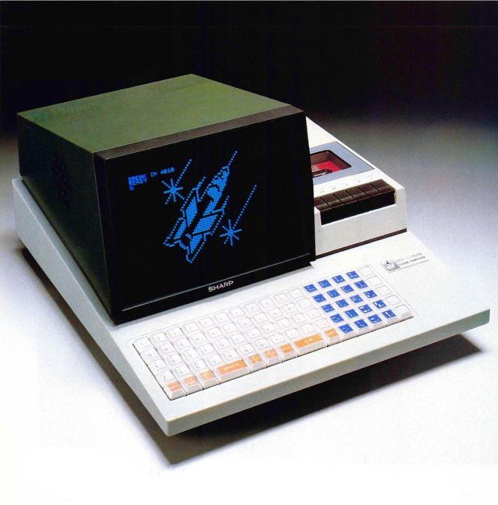
In 1978, the same year I was born (yeah, I'm ancient), Sharp introduced the MZ-80K, its first personal computer. Powered by the popular Zilog Z80, an 8-bit microprocessor that was widely used in early home and personal computers, it featured an integrated keyboard, 9-inch CRT display and cassette tape drive. The MZ-80K followed Sharp's "clean computer" concept, with no programming language built into its ROM – Microsoft, are you reading this? Instead, software such as BASIC was loaded from cassette tape. It became the first in a long line of Sharp MZ computers and marked the company's entry into the personal computer market.
Sharp Goes Portable
The Sharp PC-1211 was the world's first pocket computer. It was introduced in March 1980 and featured a 24-character LCD display, a full QWERTY keyboard and a built-in interpreter for the BASIC programming language. The PC-1211 could store and execute user-written programs. It was powered by two 4-bit processors and three 4-Kbit RAM chips. It could be connected to a printer or a cassette recorder.
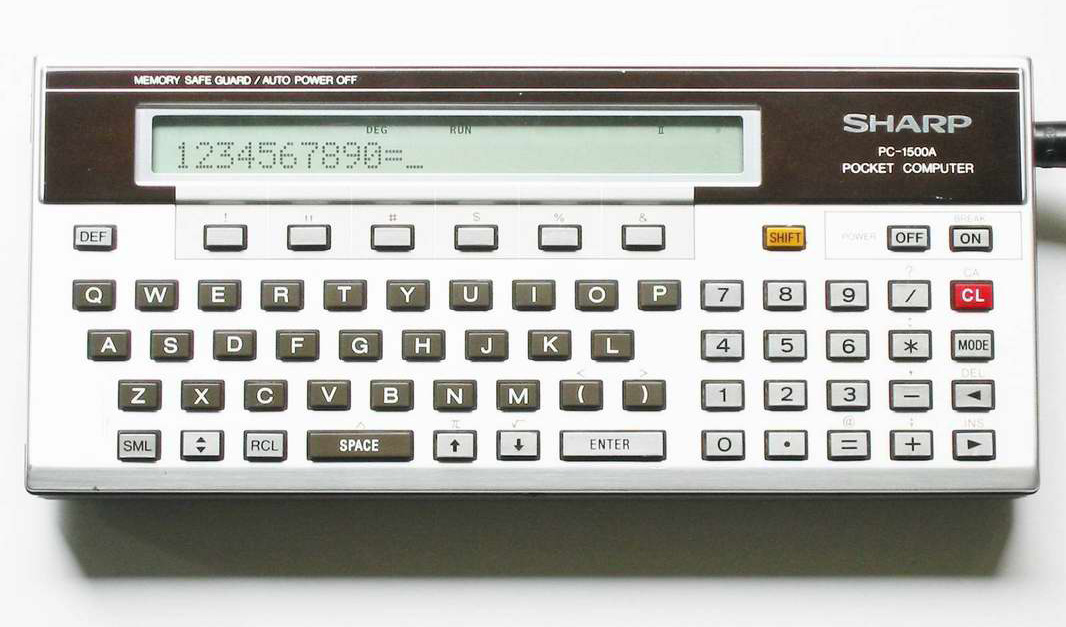
A year later, after a couple of intermediate models, Sharp released the PC-1500, which represented a major evolutionary leap in pocket computing. The device now featured an LCD with a resolution of 7 × 156 dots, an 8-bit CPU and 3.5 KB of RAM. Like its predecessor, it supported the BASIC programming language, but its architecture allowed users to expand its capabilities. For example, German engineers developed an assembler for it, and a C compiler followed later. The PC-1500 also featured an expansion slot for additional memory and ROM modules, allowing users to connect a range of accessories.
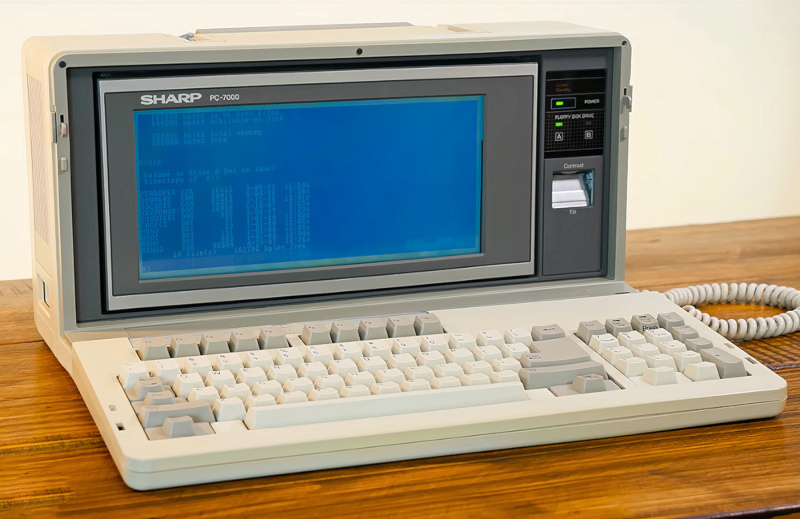
But Sharp didn't only produce pocket computers. It also made "serious", full-sized computers that could be carried around, a category known as "luggables". The PC-5000 was Sharp's first entry in this category. An early IBM PC-compatible portable, it was powered by an Intel 8088 processor and equipped with a 640 × 80 LCD display and bubble-memory storage. It was followed in 1985 by the much more capable PC-7000, which replaced the tiny display with a 10.5-inch backlit LCD and added twin 5.25-inch floppy drives, while the improved PC-7100 followed with an even better display. These machines were called portable computers, although at around 9 kg they were probably better described as computers that you could technically carry around – assuming you didn't mind developing one very muscular arm.
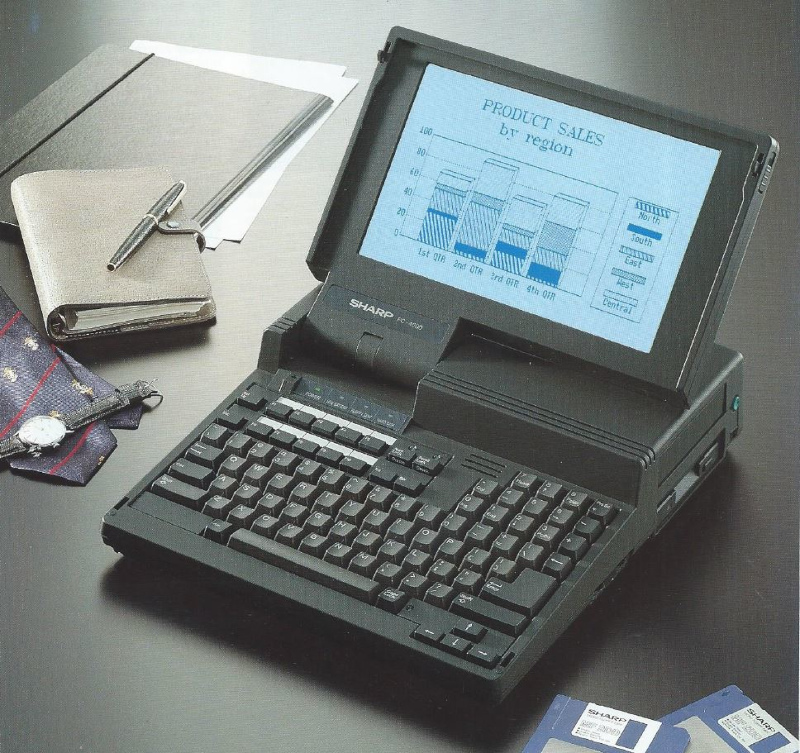
In 1987, Sharp introduced the PC-4500 series, moving its portable computers away from the bulky luggable design of the PC-7000 and into a much more familiar laptop form factor. Powered by an NEC V40 processor and running MS-DOS, the PC-4500 featured a monochrome LCD display, a built-in 3.5-inch floppy disk drive and, in the higher-end PC-4521, a 20 MB hard disk. At around 4 kg, it was still no featherweight, but compared with Sharp's previous 9–10 kg "portable" computers, this was starting to look like something you could actually take somewhere without needing a chiropractor afterwards.
Sharp Mobile Computers
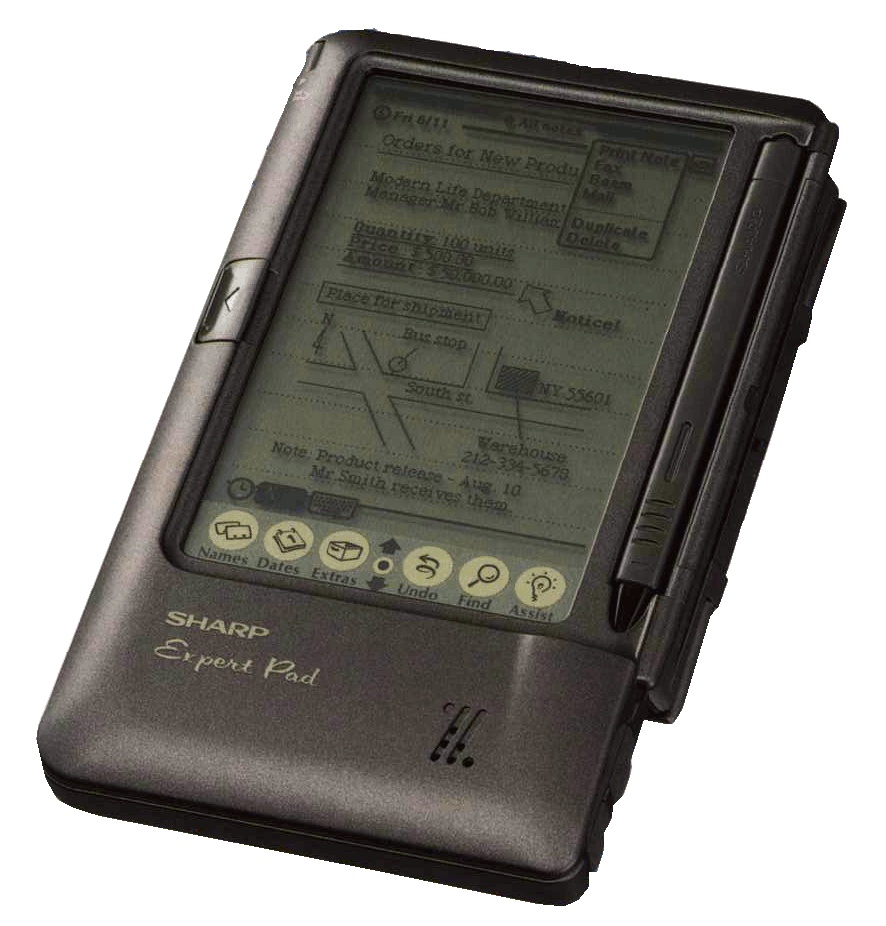
Sharp and Apple co-created a pioneering personal digital assistant (PDA) in 1993. Apple's version was called the MessagePad, while Sharp's version was called the ExpertPad. Both ran Apple's Newton OS, which was also licensed to manufacturers Digital Ocean and Motorola in 1995. The Newton platform helped establish the concept of the modern PDA, combining a touchscreen interface and handwriting recognition with personal information management tools such as a calendar, contacts and notes. Rather than simply being pocket-sized computers, these devices were designed to serve as digital assistants that users could interact with using a stylus.
As sales of the Newton OS-based ExpertPad failed to impress, Sharp abandoned the project after only two models, the PI-7000 and the PI-7100, and developed its own line of mobile computers, the Zaurus. Introduced in 1993, the Zaurus evolved from a personal organiser into a remarkably versatile handheld computer, combining features such as handwriting recognition, a calendar, contacts, fax transmission, e-mail and Internet access. Later models added colour displays, multimedia capabilities and eventually adopted the Linux operating system in 2000. The Zaurus became a major success in Japan and attracted a devoted following worldwide, particularly among programmers and technology enthusiasts, who valued its capable hardware, physical keyboards, expandability and the freedom to customise its software. Some models could even be used as miniature laptop computers, thanks to their clamshell designs and high-resolution displays. Although Sharp officially discontinued the Linux-based Zaurus series in 2008, its legacy lived on in the community that continued to develop software and alternative operating systems for these remarkably capable little machines.
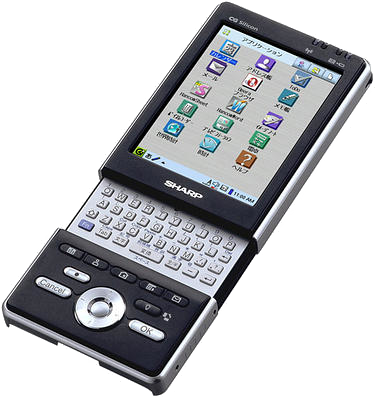
Sharp also developed mobile computers based on Microsoft's Windows platforms. From 1997 to 2010, these included touchscreen UMPCs and handheld computers with displays ranging from 5 to 10 inches. The first was the Mobilon series, launched in 1997 with Windows CE 1.0. It was followed by the Telios series, comprising miniature laptops with flip-back displays that could be folded over the keyboard to turn them into tablets. Some models also featured built-in cameras that could rotate independently. Sharp later introduced its W-ZERO3 line, running Windows Mobile and developed for the Japanese operator Willcom. The first model, the WS003SH, appeared at the end of 2005 as the world's first Pocket PC running Windows Mobile 5 with a VGA-resolution display.
In November 2009, Sharp launched a new line of mobile computers, said to be the successor to the Zaurus, named NetWalker, running Linux Ubuntu. But that was overwhelmed by the onslaught of Google's own take on Linux – and in May 2010 Sharp's first Android device came out, the IS01, a foldable QWERTY mobile communication tool with a 5-inch 960 x 480 pixel screen.
Meanwhile, two highly anticipated projects failed because the market was wary of 'revolutionary' products amid a global economic crisis. The new concept OS mobile tool, the First ELSE, was announced in November 2009 by Israeli IT company ELSE, and was rescheduled twice, first for Q2 and then for Q4 of 2010, but was officially suspended in mid-2010. Another project manufactured mainly by Sharp that was pronounced dead that same year was the Kin, itself the successor to Danger's Sidekick – a swivel-screen, full-QWERTY keyboard, internet-connected smartphone running a cloud-based OS and targeted at the young generation.
Starting in mid-2010, Sharp Japan focused exclusively on Android-based smartphones as it managed to overtake competing mobile platforms in the Japanese market in less than a year. Android-running smartphones have been released for domestic Japanese carriers NTT DOCOMO, SoftBank, au by KDDI, Willcom, and various MVNOs, as well as for China, Taiwan, Indonesia, Hong Kong, Thailand, and even Russia. Few attempts to enter the European and US markets were made but failed each time because of poor marketing (IMHO). After Foxconn acquired 66% of the shares in Sharp Corporation in 2016, several models were built by Foxconn or subsidiaries targeting the East Asian market with varying success. As of 2026, Sharp-branded smartphones hold a share below 1% in these markets.
Sharp's Technological Firsts
Sharp has a long history of pushing the boundaries of mobile technology, often introducing features that other manufacturers would take years to adopt. Here are some of the company's most notable firsts in pocket computers, mobile phones and smartphones (other than the ones mentioned above):
- In April 1999, Sharp launched the world's first VGA (480 x 640 px) display PDA, the Zaurus iCRUISE MI-EX1.
- In November 1999, Sharp launched the J-SH02, the world's first full-colour (256 colours) display phone.
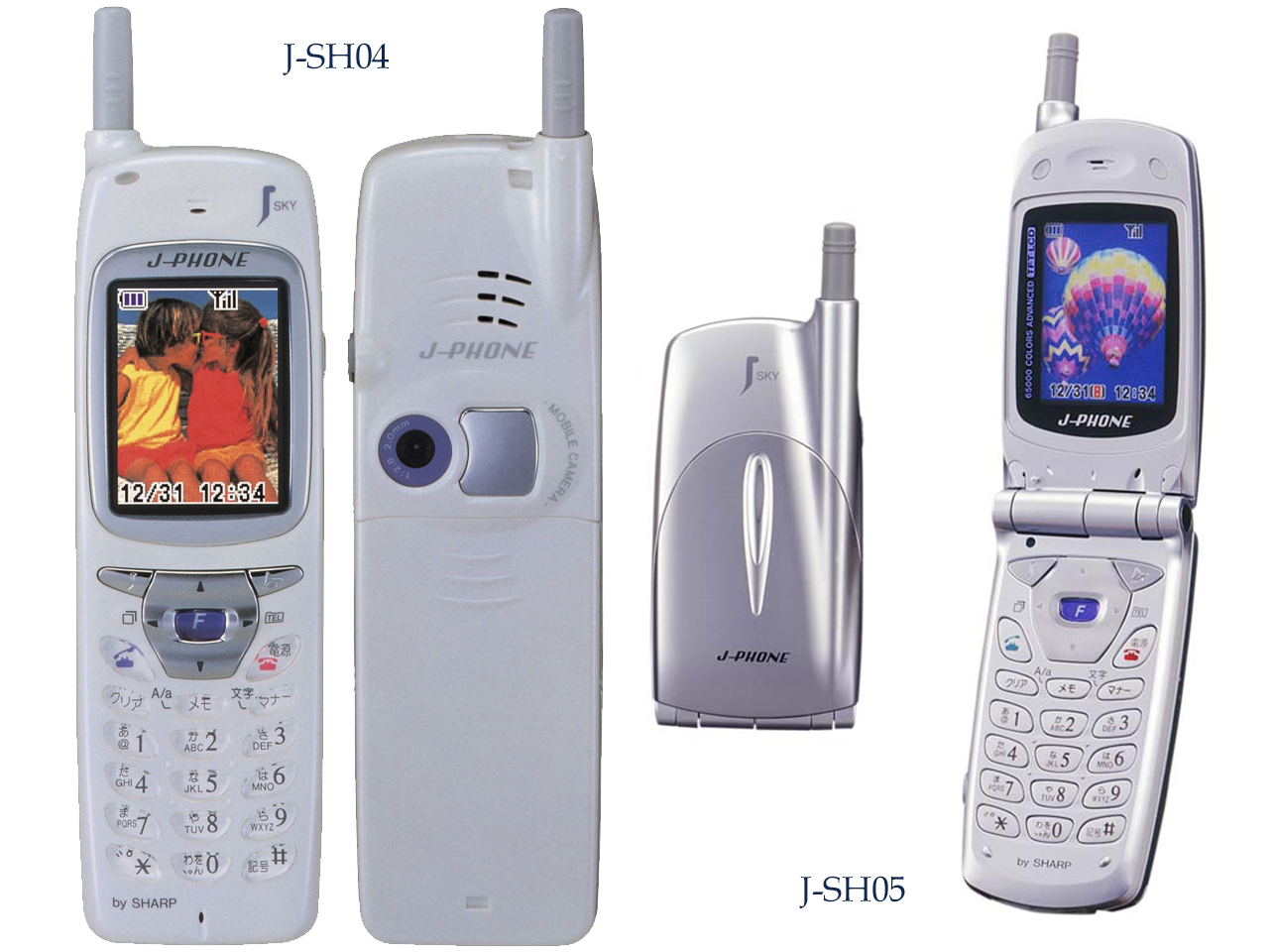
- In November 2000, Sharp launched the J-SH04, the world's second camera phone (only preceded by Kyocera's VP-210 launched in May 1999, which barely gained any popularity).
- In December 2000, the Sharp J-SH05 was the world's first mobile phone to feature a TFT colour LCD, capable of displaying 65,536 colours (16-bit colour). Earlier colour-screen phones typically used STN LCD technology and displayed just 256 colours.
- In November 2002, the Sharp SH251iS became the world's first mobile phone to incorporate a stereoscopic 3D colour screen (glasses-free).
- The J-SH010, launched in March 2003, was the first phone* to feature a QVGA (240 x 320 px) display. (* According to my own research.)
- The 902SH, released (almost) simultaneously in Japan and the UK (late December 2004 and February 2005, respectively), was the world's first phone to feature an optical-zoom camera and the first in Europe to have a 2-megapixel camera.
- Sharp released the world's first VGA (480 x 640 px) display phone, the 904SH, in February 2006. The 904SH was also the world's first face-recognition-enabled handset.
- In May 2007, the EM ONE S01SH was the world's first 800 x 480 px touchscreen mobile computer (UMPC).
- The world's first waterproof phone was the 934SH released on Softbank in August 2009, having IPX5/IPX7 certification. About a year later, in June 2010, the 841SH was launched, which was also the world's first dustproof (IP5X) phone. Almost all Sharp phones since then are both water- and dustproof.
- In October 2008, Sharp released the 931SH, which featured the first-of-a-kind full-touch 3.8-inch, 1024 x 480 px display. For comparison, iPhone 3G (2nd generation) released at the same time, featured a 3.5-inch display with a 480 x 320 px resolution. The 931SH had a 5.2-megapixel auto-focus 29-mm camera with multiple face detection and panorama shooting – features that other phone manufacturers did not introduce until 3–5 years later.
- In December 2011, the AQUOS PHONE SH-01D became the world's first phone to feature an optical image stabilisation (OIS) camera. It also has a glasses-free 3D display.
- Sharp began making very-thin-bezel phones as early as 2013 (AQUOS PHONE Xx 302SH) and created the world's first bezelless phone in 2014, the AQUOS Crystal 305SH.
- The AQUOS Zeta SH-06E, launched in May 2013, was the world's first phone to feature a camera with an f/1.9 aperture (the first to go below f/2.0).
- The SH-01G, released in November 2014, has the world's first Ricoh GR Certified camera for zero-aberration lens and high-quality digital photography that performs equally to DSLR cameras.
- The AQUOS S2, released in August 2017, was the world's first phone to use a free-form display (e.g. allows cutting camera notches and rounded corners).
- The AQUOS Zero, released in December 2018, has the world's first fully curved OLED display.
- The AQUOS R6, announced in May 2021, is the world's first phone to feature a one-inch camera sensor – jointly developed with Leica.
Keitai Garaho – Sharp's Feature Phones
It wasn't all computers for Sharp, who were also a leading manufacturer of just about any household appliance you can think of. They also made phones. And they were pioneers in this domain, too.
Sharp's feature phones, called keitai garaho in Japanese, used to be among the most popular mobile phones in Japan in the first decade of the new millennium (accounting for a quarter of the market until 2011, before shrinking to 16% in mid-2013), leaving only Apple's iPhone ahead of them. These were usually flip-open mobile phones with displays that could rotate through 180°, equipped with stunning, high-megapixel CCD cameras with optical zoom and optical image stabilisation. They made the displays and cameras on just about every non-Japanese phone sound like a joke.
The keitai garaho were subsidised by the major Japanese carriers, who competed fiercely with each other to roll out a better, more ingenious phone, inventing hardware and software features that took flagship smartphones over a decade to catch up with. SoftBank models ran a proprietary OS developed by Japanese Access Corporation, which is also known for its NetFront Browser and was also behind the revolutionary sPlay OS on the failed First ELSE. The OS was based on Linux but was heavily customised to meet the needs of Japan's second-largest mobile operator. Together with Japan's leading mobile operator, NTT DoCoMo, Sharp made a number of mobile phone lines, all using a custom-tailored operating environment based on Symbian. Although traditionally partially function-locked, Japanese Sharp phones were very popular among fans worldwide because of their look, feel, quality, robustness and unmatched specifications. My first real keitai was the 904SH (after the UK-sold 902SH), an exceptional phone released in April 2006 which still works even today.
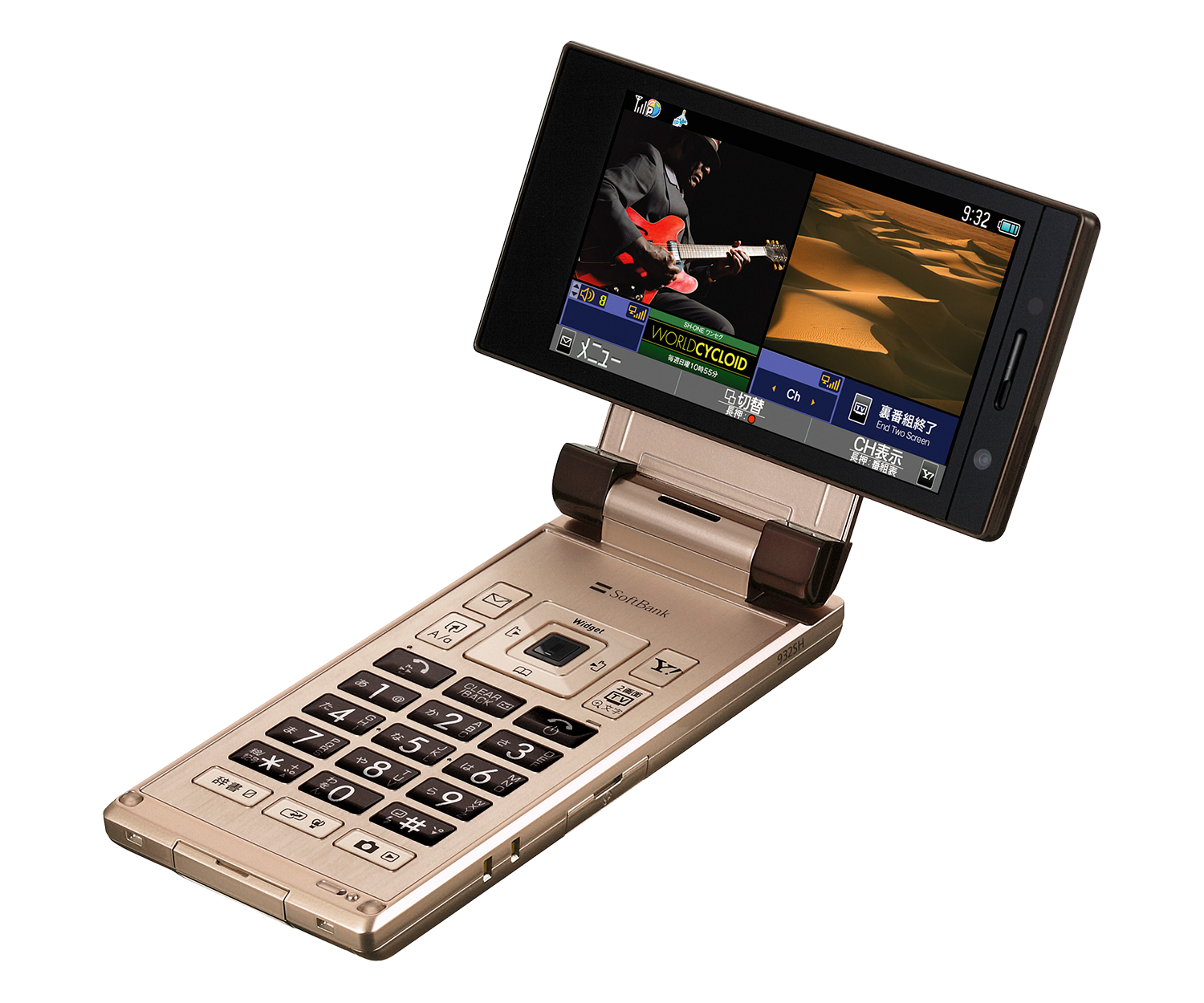
Take, for example, Sharp's last non-Android keitai garaho, SoftBank's AQUOS SHOT 002SH and DoCoMo's AQUOS SHOT SH-03D. Both came with 3.4" touchscreen displays with a resolution of 854 x 480 dots made using the New Mobile ASV technology capable of reproducing 1.67 million colours, equipped with external 0.9" monochrome OLED notification displays. These phones were, like many others before them, waterproof (IPX5/IPX7) and dustproof (IP5X), had HDMI ports for connecting to your AQUOS LCD TV, as well as high-speed Wi-Fi, digital terrestrial television (One Seg), Bluetooth, Infrared, GPS, remote lock, a ton of other apps, and support for microSDHC cards of up to 32 GB. The camera, oh, the camera: a 16.1-megapixel CCD sensor (the type used in professional cameras) that could start up in just 0.5 seconds and shoot 1080p Full HD video at 30 fps. It was equipped with dual microphones for stereo sound recording, autofocus and optical image stabilisation, as well as face recognition, pet detection (so it could recognise and focus on the faces of cats and dogs!) and high-speed continuous shooting with automatic selection of the best photos (camera AI, but in 2010). Naturally, it came with Japan's contactless digital payment service FeliCa and with wireless alerts.
But by mid-2011, Android OS was already the dominant platform for mobile devices and very few keitais were released running the old proprietary operating systems. The SH-03D and the 002SH were the last to see the light of day in the Winter 2011 collection. SoftBank actually made an attempt at prolonging the life of flip keitais with the Aquos Phone The Hybrid, codenamed 007SH, which ran Android 2.3. This was, sadly, short-lived, as the slate/slab form factor with its potential for larger touch-operated screens had already gained the upper hand, notoriously through the appeal of the iPhone.
Flip-keitai that were released between 2012 and 2015 continued to employ their non-smart OSs but were now low- to mid-range phones with nothing to impress. Eventually, Android arrived even in traditional 'garaho', or feature phones – in its spring 2015 collection, au launched the Aquos K SHF31, which boasted some impressive specs and had a heavily customised Android 4.4. It failed to achieve the market impact that had been hoped for, and remained the last flip keitai to have a great camera: all garaho phones made after it have feeble cameras, the lowest-grade processors and barely sufficient RAM – and don't even have touchscreens.
Global Usability
Sharp have always been excessively protective with their phones. To date, no one has managed to unlock the bootloader of a Sharp smartphone – hence, it is impossible to install an OS, or a version of an OS, that is different from what Sharp has officially sanctioned. The traditional keitai could only be partially unlocked to work with a different SIM card through the use of HyperSIMs, 1-mm-thick devices that you stick to your SIM card, after cutting a corner to accommodate the slightly bulkier chip at one end. This would enable radio reception, meaning that you could use your Japanese phone for calls and SMS, but not for mobile data. The multimedia features (camera, video player, audio player) on high-end SoftBank garahos were SIM-locked – luckily, the DoCoMo models did not have a multimedia lock. A software unlock was developed for a couple of these phones but was prohibitively expensive (over US$100).
Although in 2011 the Japanese government issued a recommendation to mobile operators to remove the SIM lock upon request, only DoCoMo complied. Thus, SoftBank's phones, including the glasses-free 3D Android phones 003SH, 005SH, 007SH and subsequent models, remained usable only through the use of HyperSIMs. In 2013, a full software unlock was developed for just those models (because they had the same processor). Luckily for those remaining keitai fans, the Japanese government reissued its SIM-unlocking policy in 2015, this time making it an order rather than a recommendation. Thus, every Japanese phone released after 1 May 2015 could be SIM-unlocked, usually for a fee (read more in the News section of this website). Meanwhile, Sharp continued to enhance the security of its phones, and no device released with Android 5.0 or later can be rooted. Since mid-2021, all Sharp phones have been sold factory-unlocked, so using one outside Japan is simply a matter of checking whether it supports the appropriate frequency bands for your region.
Sharp Notebooks and Laptops
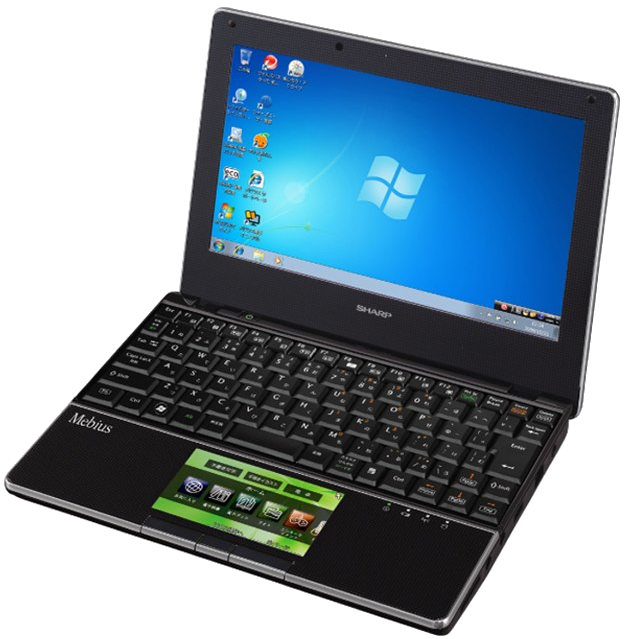
Sharp produced its own range of laptops (netbooks, notebooks, and full-fledged laptops) in display sizes including 7.2", 10.1", 10.4", 11.3", 12.1", 13.3", 14", 14.1", 15", and 15.4". The vast majority of the 100+ models Sharp built and sold, mainly in Japan, under the Mebius brand, were your typical high-end machines with great specs for their time. A few that marked some kind of milestone for Sharp and/or the industry have been added to the catalogue. These include Sharp's very first Mebius notebook from 1995, the world's first widescreen notebook from 1996, the world's largest display in B5 format from 1998, the world's thinnest and lightest 12.1" notebook from 2001, the ultra-portable 7.2" 1280 × 768 px netbook (again a world-first), the world's first glasses-free 3D-screen laptop, and the world's first (and only) portable computer to use an optical-sensor LCD touchpad. Curiously, Sharp's cutting-edge IGZO LCD and then IGZO OLED display technology was not implemented in any of its own machines save for the Mebius Pad – but stupid-high-resolution IGZO displays were and are installed in a range of top-brand machines made by Fujitsu, Dell, Razer, Toshiba, Lenovo, NEC, Apple, Cube, Teclast, and Onda, as well as in NEC and Dell monitors.
Sharp's involvement in the PC business expanded considerably in October 2018, when it acquired an 80.1% stake in Toshiba's computer business, then known as Toshiba Client Solutions. The company was renamed Dynabook in January 2019, and Sharp acquired the remaining shares in August 2020, making Dynabook a wholly owned subsidiary. Dynabook continues to develop a range of personal computers, including lightweight laptops, detachable 2-in-1 devices with removable keyboards, and compact business notebooks. Many models feature IGZO LCDs, but the IGZO OLED technology used in Sharp's flagship AQUOS smartphones has yet to make its way into Dynabook laptops.