IGZO
Last updated: 11 October 2026 – 23:17IGZO What?
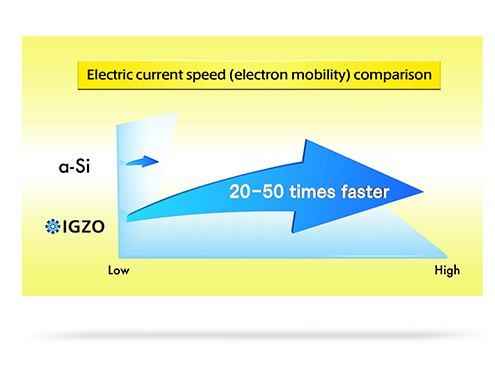
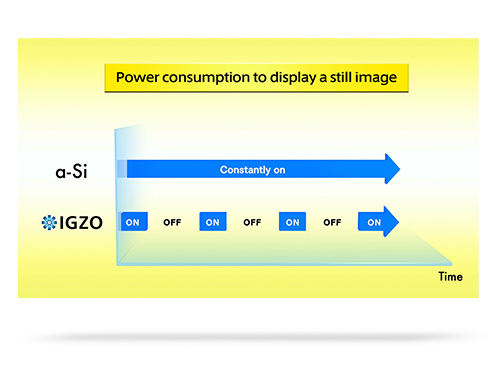
IGZO stands for indium gallium zinc oxide, a transparent oxide semiconductor used in the thin-film transistors (TFTs) that control individual pixels in a display. Sharp developed the technology in cooperation with Semiconductor Energy Laboratory Co., Ltd. (SEL) and commercialised IGZO LCD panels in 2012, replacing the conventional amorphous-silicon (a-Si) TFT technology used in many LCDs until then. IGZO offers much higher electron mobility, allowing smaller transistors, greater light transmission, higher pixel densities and lower power consumption. It can also retain a still image without continuously refreshing it, further reducing power use. In comparison, all other technologies must refresh the LCD continuously, even when you are looking at a still image for 20 seconds or five minutes.
It is important to note that, while Sharp initially used IGZO in its LCD panels, the technology can also be used in conjunction with OLED panels, as became the case some ten years later.
Naturally, Sharp continued refining IGZO after its initial launch. In June 2012, Sharp and Semiconductor Energy Laboratory announced a more crystalline form called CAAC-IGZO (C-Axis Aligned Crystal). Its improved stability under electrical and light stress made it a significant development. This was not officially labelled “second generation”, but we now distinguish it as such retrospectively.
That said, I have not been able to identify any Sharp-branded smart devices that used first-generation IGZO panels. The AQUOS PHONE Zeta SH-02E, announced in October 2012 and released at the end of November that year, was officially the first IGZO LCD model. It is known to use CAAC-IGZO, as does the AQUOS Pad SHT21, along with some 4K LCD monitors launched in late 2012.
Of course, not every model Sharp launched after 2012 featured an IGZO panel, possibly because the technology was still new and some carriers did not want to use it in their flagship smartphones. When announced in late 2012, the AQUOS PHONE Xx 203SH was supposed to have an S-CG Silicon LCD, but when it came off the production lines in March 2013, it was understood that SoftBank had opted for the new IGZO technology. SoftBank must not have been very happy with its first IGZO smartphone, though, because, by the Summer 2013 collection, au’s AQUOS PHONE SERIE SHL22 and DoCoMo’s AQUOS PHONE ZETA SH-06E both used IGZO, while the AQUOS PHONE Xx 206SH preferred to stick with the S-CG Silicon LCD.
The Winter 2013/Spring 2014 collection brought the next, third generation of IGZO panels, with high resolution and an unheard-of (at the time) pixel density of 440 ppi. These panels also supported the HSV colour space. They can be found in the AQUOS PHONE Zeta SH-01F and the AQUOS PHONE Serie SHL23, but not in the AQUOS PHONE Xx 302SH. Eventually, however, IGZO panels became the norm in flagship models. By Winter 2015, even SoftBank was using one in its AQUOS Xx2 502SH, now with a 120 Hz display refresh rate.
The 120 Hz refresh rate became standard in the fourth generation of the technology, now explicitly identified as IGZO4, with mass production starting in the fourth quarter of 2016. The major innovation in this generation, however, was the integration of the touch sensors into the liquid crystal display, effectively eliminating the need for a separate digitiser. The new idling-stop IGZO technology, combined with an in-cell touch LCD, was first offered in the mid-range AQUOS Ever SH-02J for DoCoMo and the AQUOS U SHV37 for au. The experiment must have proved successful, because the flagship AQUOS R and AQUOS R compact, as well as their successors, the AQUOS R2 and AQUOS R2 compact, used in-cell IGZO LCDs.
Sharp announced the fifth generation of IGZO, dubbed Pro IGZO LCD, on 24 April 2019. It improved electron mobility by approximately 50% over IGZO4, reaching around 30 times that of conventional amorphous-silicon TFTs. This enabled even smoother high-refresh-rate displays, lower power consumption, smaller transistors and narrower screen bezels. Sharp initially highlighted its application in an 80-inch 8K television and announced that production technology for small- and medium-sized panels had also been developed. The AQUOS R3, announced in May 2019, was the first smartphone to feature the Pro IGZO LCD, followed by the AQUOS R5G in early 2020. This, however, marked the beginning of the end for IGZO LCDs, as Sharp shifted its focus to OLED.
OLED and IGZO OLED
Sharp began manufacturing its own OLED displays in June 2018 and launched its first OLED smartphone, the AQUOS zero, that same year. As Foxconn had failed to win the display-supply contracts for the 2019 iPhones, the decision was made to discontinue production in September 2019. However, Sharp did launch the AQUOS zero2, its second smartphone to feature its own OLED panel. The announcement did not seem to lead to actual discontinuation, as Sharp and Japan Broadcasting Corporation (NHK) co-developed a 30-inch flexible OLED in November that same year. Then came the AQUOS zero5G (2020) and AQUOS zero6 (2021), again with Sharp’s own OLED panels, but now with 240 Hz refresh rates.
The Summer 2021 collection saw the first IGZO OLED displays, appearing in the flagship AQUOS R6 (launched in June 2021) and the mid-range AQUOS sense6 (launched in September 2021). The former was announced as “Pro IGZO OLED” and the latter as “IGZO OLED”. The difference was the adaptive 1–240 Hz refresh rate on the flagship (another world first), while the latter could switch between 60 Hz and 120 Hz refresh rates.
All flagships launched by Sharp since then, up until late 2024, featured Pro IGZO OLED, whereas most mid-range and low-end models were built using IGZO OLED. The few exceptions, such as the AQUOS wish4 and AQUOS wish5, also started using high-speed displays (90 Hz and 120 Hz, respectively), although not IGZO, showing that Sharp has not abandoned the earlier technologies it developed before IGZO and OLED. However, Sharp shut down its OLED manufacturing plant in Sakai in 2024, reporting substantial losses and an inability to compete with other suppliers. This raises the question of who supplies the OLED panels for devices, including smartphones and laptops, made after 2024. We know that Sharp began cooperating with LG on OLED panels for its TVs as far back as 2020, and with Samsung in 2023, when it launched its Quantum Dot OLED TVs in Japan. We also know that, as recently as September 2026, it was announced that LG Display would become the sole supplier of OLED panels for AQUOS TVs, with the range expanding to include 40-inch models alongside the previous 55-, 65- and 77-inch models. We do not know for certain whether LG manufactures the sub-10-inch OLED panels found in mobile phones, but who else could it be?